A Merkle Root is the hash of all the transactions in a block by hashing transactions and again hashing those results in pair till the time there exists only a single hash result for the entire block.
These values play a critical role in ensuing blockchain security and are also used to create Zero Knowledge rollups and Blobs in Sharding of the Ethereum Blockchain.
The map of all the hashes are called as the Merkle Tree or even Hash Trees as they are obtained from hashing. The concepts were invented by computer scientist Ralph Merkle in 1998. You can read his original paper here.
Table of Contents
How is a Merkle Root obtained?
In a block, there exists multiple transactions. To generate a Merkle Root from all the transactions,:
The transactions are first hashed to obtain a transaction result.
Then the results are again hashed.
Each step reduces the number of valued to be hashed by half.
This is continued till the time there exists only a single hash result.
Merkle Tree with a Merkle Root (R)
Example
Suppose there are four transactions in a block which are hashed to generate hash results A, B, C and D.
I have depicted in the diagram above that transactionhashes A and B are hashed again to obtain a hash result X and similarly transaction hashes C and D are hashed to obtain hash result Y. Now, hash results X and Y are again hashed together to obtain hash result R. Since there is no other value left to hash with R, it is considered to be the Merkle Root.
How Merkle Root Secures the Blockchain?
Each transaction is unique in the blockchain and the hashing of two unique transactions produce a unique result.
If there is a slight change in one transaction detail, this change will be reflected in its hash. This change in hash value will continue till it changes the value of the old Merkle Root to a new value.
Now. if you compare the original Merkle tree(left) and the changed Merkle Tree(right) after transaction 1 changes to 1*, you will notice that there is a series of changes as a result.
A changes to A*
X changes to X*
Merkle Root R changes to R*
Therefore, if any hacker changes the value of a transaction, it will soon be reflected in the new Merkle root and will be identified soon because other it will not match with the Merkle root of that block with other verifiers.
As soon as an anomaly is detected in the Merkle root, it can then be traced which transactions were tampered with. In our example, the tampered transaction 1 can be detected by starting at Merkle Root and going upwards.
Consensus Mechanisms are different ways to verify blockchain transactions by running it through multiple validators each of whom verifies them individually.
Note, that throughout the article, the terms Consensus Mechanism, Consensus Protocol and Consensus Algorithm have been used interchangeable and have the same meaning.
Table of Contents
Need for Consensus Mechanisms
Consensus Mechanisms essentially make sure that every blockchain transaction is genuine. This helps the blockchain remain secure since each user is confident that their funds are safe. Therefore, the most important job of a consensus mechanism is to ensure the safety of the blockchain.
History of Consensus Mechanisms
Consensus Mechanisms were first developed successfully using the Bitcoin blockchain where verifiers(miners). Later, as Bitcoin grew in size, there were concerns that it might be unsustainable. Other blockchains could not use its consensus mechanism (Proof of Work). This was primarily because of its high energy consumption.
The came the existence of blockchains like Algorand which was based on Pure Proof of Stake. Such blockchains were using 99.9% less energy than Bitcoin with remarkable security.
Ethereum’s Transition from Proof of Work to Proof of Stake via the Merge
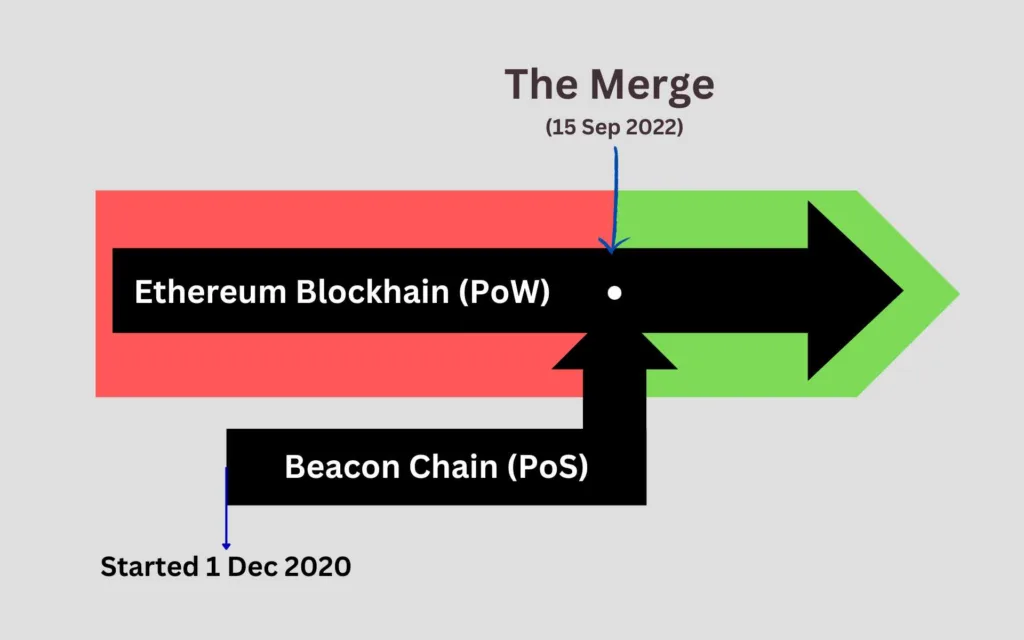
Later in 2022, Ethereum too changed from Proof of Work to Proof of Stake through a year-long event ending on 15 September 2023, called the Merge. The name was so because it merged an existing Proof of Work blockchain with a new blockchain called the Beacon Chain which was created in Proof of Stake.
How do Consensus Mechanisms Work?
Let me give you a broad overview of how consensus mechanisms work. Though there are differences, yet the basic process is all the same.
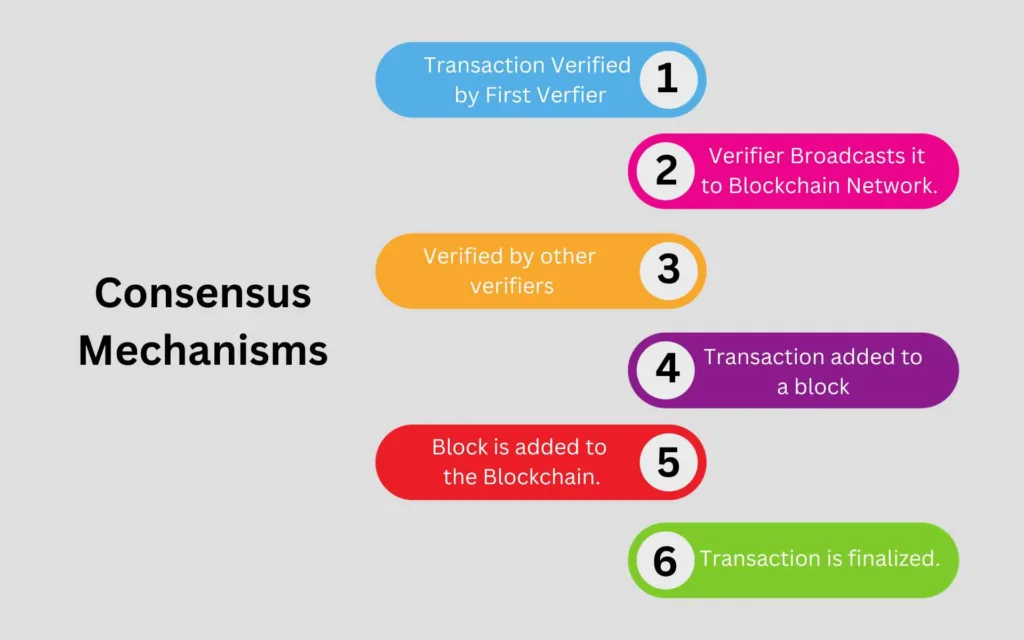
Consensus mechanisms basically need to make sure that the distributed ledger of a blockchain stays true. This is done through the following steps:
When a transaction is initiated, it is verified by a designated verifier such as a validator(PoS) or miner(PoW).
Then the verifier broadcasts the transaction to the network.
Multiple verifiers, other than the first verifier, also verify the transactions.
After the transaction is verified by a certain number of verifiers, it is added to a block.
The block is then added to a blockchain when it has sufficient numbers of transactions.
Centralized consensus algorithms are the ones where decision making and authorization of transactions take place in a top down approach. A few verifiers validate all the transactions. Usually I have seen these kind of mechanisms in permissioned blockchains such as Hyperledger where even a single authority such as a company’s CEO authorizes the blockchain transactions.
In Decentralized consensus algorithms, the number of verifiers are higher, with more power and they are often geographically distributed. Here, the transactions are verified in a democratic process. Usually some kind of mechanism is put so that they do not act in a fraudulent manner.
Sybil Resistance Mechanisms vs Consensus Mechanisms
Sybil Resistance Mechanisms are those which prevent a majority takeover of a blockchain’s verifiers. These takeovers are in the form of attacks called 51% attacks.
10 Different Types of Consensus Mechanisms with Examples
Here is a list of 10 different consensus mechanisms that are used in major blockchains.
Summary
Consensus Mechanism
Pro
Con
Example
Proof of Work
Increased security
High Energy Consumption
Bitcoin, Ethereum Classic
Proof of Stake
Highly efficient and secure
Needs a high number of validators to be secure.
Ethereum, Algorand
Proof of Delegated Stake
Faster speed
Lower no of verifications
EOS, Tron
Proof of History
Very high speeds (100k TPS)
Prone to blockchain halt.
Solana
Proof of Authority
Faster and Cheaper
Less Democratic
VeChain
Proof of Delegated Authority
Delegated decision-making
Less Democratic
Private blockchains
Proof of Elapsed Time
Low energy consumption
Validators are idle most of the time.
Hyperledger Sawtooth
Proof of Burn
Easy to operate
Unsustainable when coins get short
Slimcoin
Proof of Capacity
Easy to use
Prone to hackers
Signum
Proof of Contribution
1. Proof of Work (PoW)
This was the first consensus mechanism to come into existence with Bitcoin’s blockchain. Here, transaction verifiers, also called as miners, run complex calculations to guess the nonce value which is unique for every transaction. These nonce values are obtained from the hashing function with the following inputs (non-exhaustive list):
Transaction amount
Public address of receiver
Private key of sender
Hash of previous transaction
Examples of Proof of Work Blockchains:
How does Proof of Work Functions
Bitcoin
Dogecoin
Ethereum Classic
2. Proof of Stake (PoS)
In this consensus mechanism, the transactions are verified by validators who have to stake some collateral (32 ETH in Ethereum) to be able to sign transaction. Any mistake or faulty behavior of the validators can lead to a partial or total loss of their stake.
The working of Proof of Stake is similar to Proof of Work but there is no need to perform complex calculations in the Proof of Stake consensus mechanism.
Examples of Proof of Stake Blockchains:
Ethereum
Algorand
Avalanche
3. Proof of Delegated Stake (PoDS)
This is a special type of blockchain consensus protocol where instead of using their own funds to stake, validators receive funds from people called delegators. Since these delegators fund the stake for the validator, they are entitled to share the rewards that the validator generates.
A special type of election is conducted to elect witnesses (delegates) who take the role of validators. Only those who own the native Governance token are allowed to vote.
Example of Proof of Delegated Stake Blockchains:
Tron
EOS
4. Proof of History (PoH)
In Proof of History, which was developed by Solana, blocks are time-stamped using function called Verifiable Delay Function(VDF). These timestamps record at what point a block was validated and also record the order of the blocks. The VDF is designed to be a computation intensive function and resists attacks from the outside.
Proof of History cannot work alone and it needs another blockchain consensus to verify individual transactions, which is in the case of Solana is Proof of Stake.
These blockchain consensus has a dual layer of protection and is very effective against Replay Attacks.
In the case of Solana, Proof of History achieves a theoretical transaction speed of 100k per second.
5. Proof of Authority (PoA)
In this type of blockchain, the command structure follows a top-down approach. Here, transaction verifiers are selected and authorized to validate transactions. Selection can be from done by a top authority such as leadership of an organization or through a vote by token holders.
Example of Proof of Authority consensus:
VeChain uses this consensus mechanism to select its 101 blockchain validators which are called as Masternode Operators. This helps VeChain operate its blockchain in an energy efficient way. As per its claims VeChain uses only 0.04% of energy as compared to other blockchains.
6. Proof of Delegated Authority (PoDA)
In the proof of delegated authority consensus mechanism, the validators are selected by the key decision makers. This is opposed to Proof of Authority where a decision maker is directly responsible for validating blockchain transactions.
The consensus mechanism is mostly seen in private blockchains where day to day decision making is done through and recoded on blockchains.
7. Proof of Elapsed Time (PoET)
In Proof of Elapsed Time, every validator generates a random waiting (using a function) time after which they are allotted a block. They then add transactions to the block and then the next validator whose waiting time is overtakes the creation of the next block.
How Proof of Elapsed Time Works
It was invented by Intel Inc in early 2016 in collaboration with Hyperledger, IBM and Linux Project. The primary aim of this project is to reduce the energy consumption in Proof of Work blockchains.
8. Proof of Burn (PoB)
In Proof of Burn, the validators are required to burn the native coins to be able to verify transactions. The greater the number of tokens burnt, the higher will be their share in validating transactions. Tokens are sent to a dead irrecoverable wallet for burning.
It was invented by Iain Stewart.
Tokens are mostly sold to validators during ICOs or can be bought from the market.
Since, after buying tokens, the validators already have a stake in securing the blockchain, it creates a mental barrier against any ill thought plan to sabotage the blockchain.
Example of Proof of Burn consensus mechanism:
Slimcoin
9. Proof of Capacity (PoC)
In this type of consensus mechanism, local hard drive of the validator is used to store a list of possible solutions to the function that is run for validation. If there is a large space on the computer, a larger list of solutions can be stored and therefore a larger probability of discovering the right solutions and add it to blocks.
One key disadvantage of Proof of Capacity is that a hacker could obtain an virtual computer on the cloud to have infinite storage and therefore legally could mine all or a major chunk of the crypto alone.
Example of Proof of Capacity consensus mechanism:
Signum
Chia
Spacemint
10. Proof of Contribution (PoCo)
Here, the contribution of users and their behavior is recorded and those with the highest contributions in a consensus round are rewarded a block. The benefit is that it does not rely on a cryptocurrency to become a validator unlike Ethereum.
Proof of Contribution consensus mechanism was built by Hongyu Song, Nafei Zhu, Ruixin Xue, Jingsha He, Kun Zang and Jianyu Wang to secure Intellectual Property Rights without the use of a cryptocurrency.
Frequently Asked Questions
What is the best crypto Consensus Mechanism?
In my experience, if you prefer safety, Proof of Work is the best. If you prefer centralization, permissioned mechanisms like Proof of Authority is best. If you prefer a lean consensus mechanism with safety, Proof of Stake works best.
Is Bitcoin based on Consensus Mechanism?
Yes, Bitcoin was the first blockchain which had established the practical usage of a consensus mechanism which was Proof of Work on which it is based.
What is Ripple’s Consensus Mechanism?
Ripple uses the Federated Byzantine Agreement Model for its consensus and it is called as RPCA (Ripple Protocol Consensus Algorithm).
Which Consensus protocol is fastest?
The fastest consensus protocol as far as I have seen is possible with Proof of Authority since it requires much lesser number of confirmations than other consensus protocols.
Ethereum changed its Consensus Mechanism from what to what?
In 2022, Ethereum changed its consensus mechanism from Proof of work to Proof of Stake. This reduced its energy consumption by 99.9%.
Which Type of Novel Sybil-resistant Consensus Mechanism Does Berachain Use?
Berachain uses Proof of Liquidity protocol which is based on the principle that higher the liquidity, higher will be the trust on the liquidity provider.
What is the concept of Consensus Mechanism in Blockchain?
In blockchain, the concept of consensus mechanism tests the validity of every transaction and then spreads the valid transaction to other nodes for multiple verifications. This helps in avoiding a single point failure for authentication.
A mainnet is the main blockchain network on which cryptocurrencies are transacted. Whereas a testnet is a replica of the mainnet with reduced security and reduced network capacity.
Table of Contents
Why create a separate Testnet?
Testnets are akin to sandboxes in software development. They are used to test a feature which is not yet implemented on the main blockchain. These testnets are a way to test blockchain features and even DApps that are about to go live on the mainnet.
A testnet is a cheaper way to simulate the working of the mainnet because of several reasons.
The first reason is that the testnet requires much lesser security than the mainnet. For example,. in Ethereum the mainnet has around 900k validators while the Goerli testnet has only aboout 1800 validators.
A second reason is testnet cryptocurrencies such as Sepolia ETH or Goerli ETH are available for free and therefore are worthless. Also Testnet ETH cannot be converted into Mainnet ETH.
#NOTE: During shortages, Gloerli ETH happens to be sold to the developers who need it to test their Dapps.
List of Ethereum Testnets
Only Ethereum testnets bear a different name because Ethereum has more than one testnet. Another testnet with its own unique name is Polygon’s Mumbai.
In other cases, the testnet bears the same name as the mainnet with just the word “testnet” suffixed to it.
Goerli – deprecated
Sepolia
Holesky
Rinkeby -Sunsettted
Kovan – Sunsetted
#NOTE: Sunsetted means the project is permanently shut down. Deprecated means it is out of use and could be soon shut down.
How to Add a Testnet to MetaMask?
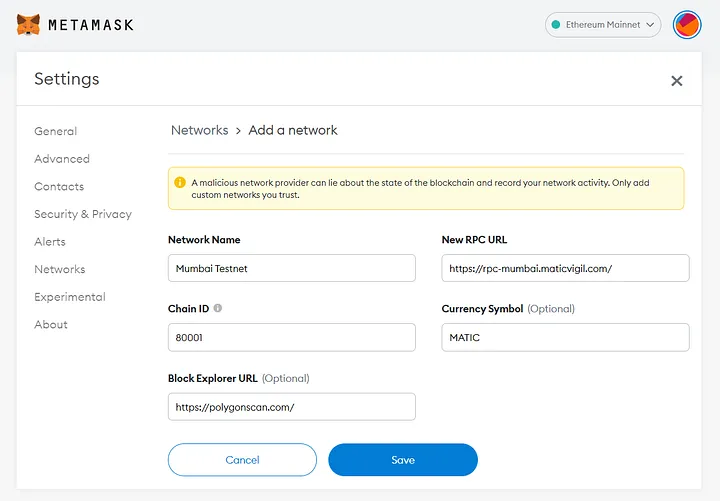
Testnets have to be added as custom networks in MetaMask.
Adding a Custom Network on MetaMask
Currently only Sepolia and Holesky testnets are active in Ethereum. Others have either been deprecated or sunsetted.
Ethereum – Sepolia Testnet
To add Sepolia Testnet to MetaMask, click on impport token and then select custom import. Add the following details to add the testnet.
Network Name: Sepolia Test Network
New RPC URL: https://sepolia.infura.io/v3/
Chain ID: 11155111
Currency Symbol: SepoliaETH
Block Explorer URL: https://sepolia.etherscan.io
Ethereum – Holesky
Network Name: Holesky
New RPC URL: https://rpc.holesky.ethpandaops.io
Chain ID: 17000
Currency Symbol: ETH
Block Explorer URL: https://dora.holesky.ethpandaops.io/
Polygon Testnet – Mumbai
Network Name: Mumbai Testnet
New RPC URL: https://rpc-mumbai.maticvigil.com/
Chain ID: 80001
Currency Symbol: MATIC
Block Explorer URL: https://polygonscan.com/
Frequently Asked Questions
How do I get Testnet ETH for Ethereum?
You can get testnet ETH from the following faucets: 1. Goerli Faucet 2. Moralis Web3
How do I start developing on Ethereum Testnet?
You need to learn Solidity to create smart contracts and basic programming to design the frontend of the DApp on Ethereum.
After that you can add some testnet ETH to your wallet. Make sure not to send real ETH to testnet otherwise it will lead to a loss.
Develop a smart contract using Remix IDE or any other Solidity IDE.
Go to Goerli.Net or any other testnet terminal to deploy your DApp.
Do all blockchains have Testnet?
Yes, a testnet is necessary to test the blockchain features. Therfore, most blockchains do have an active testnet.
Sharding is the process of breaking a blockchain’s consensus mechanism(total no. of validators) into smaller units called “Shards”. Each shard has its own unique set of validators. This increases the capacity of a blockchain by the same multiple as the number of shards.
Listen to this article as an Audio Podcast.
Table of Contents
Definition of Sharding
Sharding can be defined as dividing the entire set of validators of the blockchain into smaller units. These smaller units are called as shards. Each shard has its own unique set of validators.
The Need for Sharding
The current methods of scaling poses the risk of off-chain tampering in ZK rollups as well as inclusion of undetected tampering in OP rollups.
Currently, these two scaling methods are at work to scale Ethereum.
Scaling methods like Optimistic Rollups use call-data to store transaction records on Ethereum blocks. Call data is a empty space in a block that is not verified through consensus mechanism. However it makes the block heavier.
Zero Knowledge Rollups, another scaling solution verifies transactions on a second blockchain and stores the summary of these transactions as a single transaction on Ethereum. If the final state change after the transaction is as expected, the summary is considered as valid.
However, these methods are not the final solution as Ethereum will forever depend on them to scale up. Also there is a possibility that someday one of them might ultimately replace ethereum.
Also, the number of validators on Ethereum (more than 900k) will not be efficiently utilized. Dividing them into independent groups make much more sense as blockchains even with small groups work fine in Proof of Stake systems.
Algorand has 110 validators
Shibarium has 100 slots for validators
Polygon has 100 validators
How Sharding Works?
In a blockchain, consensus is achieved after all or maximum number of validators verify the transaction.
Sharding in Ethereum
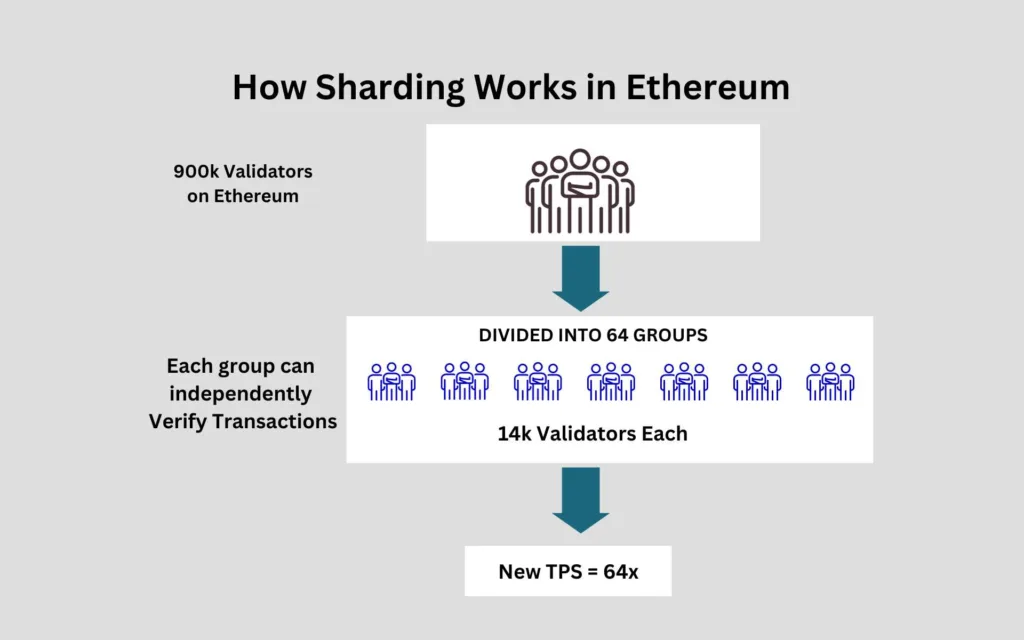
Now, for big blockchains, like Ethereum, which has over 900k validators, running each transaction through all the validators does not make much sense. Blockchains can be even secured with lesser number of validators.
So, what sharding proposes is dividing these 900k validators into 64 groups (via the Danksharding Proposal). Each group will have more than 14k validators which is enough to secure transactions and prevent 51% attacks.
Since each shard will be able to act independently, each of them can add blocks to the blockchain. Therefore, now the speed of Ethereum can be 64 times higher (theoretically) than the current speed of 10-15 transactions per second.
Sharding vs Proto-Dank Sharding
In sharding the total no of validators are divided into independent groups each of which is able to add blocks to the blockchain.
However, this is not easy to implement in Ethereum considering its security and size. Therefore, the Ethereum Improvement Proposal (EIP-4844) seeks to implement another technique called as proto-dank sharding.
Proto Dank Sharding
Proto-Dank sharding is the implementation of Sharding on the Ethereum blockchain but in a way which is feasible right now.
It was named after two Ethereum researchers Protolambda and Dankrad Feist.
It proposes to add “blobs” to the Ethereum blocks which can store transactions similar to call data in optimistic rollups. Unlike call data which stays on the blockchain forever, these blobs can be deleted after 3 months which is enough for finality of transactions.
Since, they are not processed by the EVM, their
The current number of validators are not split in Proto-Dank sharding.
Finality refers to the situation where a blockchain transaction is permanent and cannot be reversed. Finality is confirmed in a blockchain with its consensus mechanism where each validator validates the transaction and this contributes to finalize it.
Finality is important on a blockchain because it makes the latter immutable and secure. If a transaction can be changed at any time, then there could be a loss of funds.
Table of Contents
Why is Finality Necessary?
To Make Sure You Own 100% of Your Funds
Let me explain it to you with an example. Suppose you run a grocery shop and get payments using Google Pay. Think about a customer who buys from your shop, pays with Google Pay and leaves. After some time, you notice that they have reversed the transaction and your money is now gone.
How would you feel?
This is the exact reason why finality is important. It is to make sure that whoever sends or receives crypto has complete control over their funds.
Without finality, it would be impossible to have full control over your funds.
Finality also Prevents Double Spending
Double spending is a way where a single crypto token could be spent more than once. This was the reason why initial cryptocurrencies like Bit Gold failed.
To eliminate double spending, it is made sure that after every transaction, the sender’s wallet is deducted and the receiver’s wallet is credited. This is done through a process called a consensus mechanism.
Each validator confirms that a certain transaction is genuine.
After confirmation, the validator adds the block to a blockchain.
Users can only their received funds once a certain number of blocks have passed after they have received crypto.
Finality of Different Blockchains
Each blockchain has a certain number of blocks/no of confirmations which must happen to finalize a transaction.
Below is the number of confirmations that is used by Coinbase to add finality to their transactions.
Bitcoin – 2 Confirmations (6 Confirmations are very secure)
Ethereum – 12 Confirmations
Litecoin – 5 Confirmations
Factors Affecting Finality
Although there are several factors that affect latency, here are the top most ones.
Hard Forks
Hard Forks are changes in the blockchain which make it difficult for blockchains to recognize or accept transfers from their pre-fork blockchain.
CASE – The Ethereum DAO Attack
The most high-profile case where I have witnessed hard forks negatively affecting blockchain transactions was the Ethereum DAO Attack. The attacker stole 5% of the total ETH supply which was 1/3rd of the DAO’s value. The community proposed to rollback the hacker’s transaction through a hard fork. This led to a disagreement between community members.
Eventually, the disagreement to do a hard fork led to the creation of Ethereum Classic by those who opposed the hard fork.
Network Latency
Network latency causes a delay in communications between validators which makes the blockchain slower and delays block creation.
51% Attacks
Attacks where the hackers steal more than 50% of the controlling power of the blockchain are called as 51% attacks. Here, they change the history of the blockchain by removing transactions from it in a way that benefits them.
For example an attacker swaps 500 ETH with Shiba Inu with a user through two transactions. He then does a 51% attack to reverse the transaction. Here, he gets to keep both the Shiba Inu as well as the Ethereum.
Types of Finality
Probabilistic Finality: Here, the likelihood of reversing a transaction decreases as time passes.
Economic Finality: In this case, it gets more and more expensive to reverse a transaction because if it is reversed the validator will lose stake.
Instant Finality: A fast blockchain leverages security with speed to provide finality in a very short time, say 1 second.
State Finality: Some blockchains like Optimism use periodic snapshots to record the state of the blockchain transactions. Once a state change has been recorded, it is impossible to reverse these transactions.
In crypto, Difficulty refers to how hard is it to find the nonce value of a transaction. If the difficulty is high, it would mean that finding the hash requires more computing. The parameter is used to prevent too many miners clogging the network.
Also difficulty ensures that the space between production of two blocks remain consistent. This brings stability into the blockchain as all blocks will now be equally sized.
Table of Contents
What is Difficulty?
Difficulty is the computational effort required to find the nonce value of a transaction in a blockchain. Nonce values are those unique numbers which are added to every transaction and are a result of hashing the following values:
Hash of the previous block
Transaction amount
Sender and Receiver addresses
During the calculation of nonce value, one must increment a value and keep repeatedly hashing the data till the resulting hash value is equal to the network’s hash difficulty.
Difficulty is used to Control Miner/Validator Population
Difficulty of a blockchain increases with the number of miners or validators because there is a limit on the number of new blocks that can be produced in a given time.
Mining difficulty is adjusted after a certain period. For Bitcoin, the mining difficulty is adjusted once every 2016 blocks.
If the number of new blocks is not controlled than an increased number of new miners will produce a high number of blocks. Since each block in a blockchain gets you some rewards (newly minted coins), therefore increased rewards will be accompanied with more coin supply. This will ultimately lead to a collapse in token price.
Therefore to limit the number of blocks that can be produced at any given time, the difficulty of a blockchain is adjusted automatically.
How is Mining Difficulty Calculated and Adjusted?
Difficulty is calculated in terms of hash power of all the validators. If the hash rate is high, it means there are more miners. Therefore, the mining difficulty has to be increased.
The mining difficulty could be calculated using a variety of formulas.
Here’s a simplified explanation of how mining difficulty is calculated in Bitcoin:
Target Block Time: The Bitcoin protocol aims to have a new block added to the blockchain approximately every 10 minutes.
Previous Difficulty: The difficulty at which the last 2016 blocks were mined.
Time Taken(Block Time): Calculate the time it took to mine the last 2016 blocks.
Adjustment Calculation: If it took less than two weeks to mine the previous 2016 blocks, the difficulty increases. If it took more than two weeks, the difficulty decreases.
New Difficulty: The difficulty is adjusted by changing the target value that miners must meet when solving the proof-of-work puzzle. A higher difficulty requires more computational power to find a valid block.
The formula for calculating the new difficulty is:
Mining Difficulty Adjustment Formula
This formula ensures that if the network is finding blocks too quickly, the difficulty increases, making it harder to find the next block. Conversely, if blocks are taking too long to mine, the difficulty decreases, making it easier.
Mining Difficulty Chart
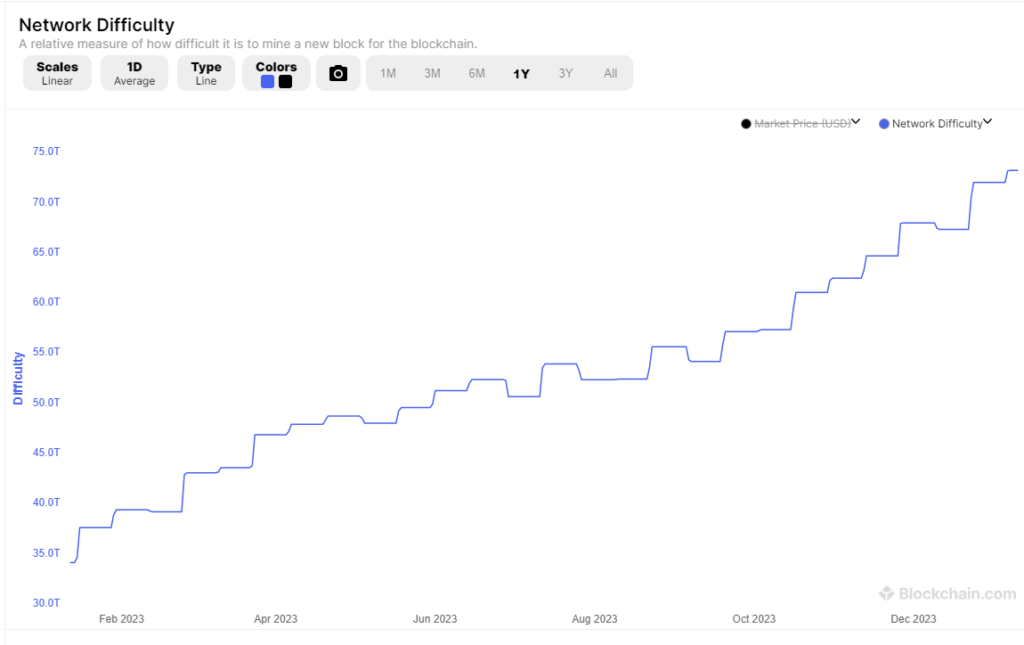
The mining difficulty chart shows how mining difficulty has changed over a given time. The mining difficulty chart for Bitcoin is shown below for the year of 2023.
Bitcoin Mining Difficulty Chart in 2023, Source: Blockchain.com
What Miners do when Difficulty Increases?
When Bitcoin mining got popular, the number of miners increased and this led to an increase in difficulty. To combat this, Bitcoin miners created mining pools where miners use to pool their computational resources and start mining as a team. With increased resources, they would now have a greater chance at discovering new blocks.
#NOTE: Block discovery works in a way where the fastest one to verify and add transactions to finish a block is the only one to be rewarded. Other blocks which could not be included in the blockchain are called orphan blocks.
Impact of Mining Difficulty
Resource Consumption
If the mining difficulty is not periodically regulated, the number of miners would rise disproportionately. This would cause an increased usage of power and computational resources (CPU, GPU). This could lead to power shortages.
An increased mining difficulty discourages new miners after a certain level.
Token Price Stability
Token prices remain relatively stable because their supply is well regulated. If there would be uncontrolled mining, then token price would also come crashing down as each miner would produce several blocks and get mining rewards.
Shiba Inu is a meme coin created by the pseudonymous developer Ryoshi as a response to Dogecoin. Initially launched as an ERC-20 meme coin on Ethereum, it has now developed its own blockchain which supports NFTs, DeFi and DEXes.
It is among the major altcoins and enjoys a very high popularity.
Table of Contents
Shiba Inu Price Today in USD
The widget below shows the latest price for Shiba Inu in US Dollars and also shows the percentage of ups and downs in the last 24 hours.
There is also a miniature unlabeled graph on the right-side of the price.
Tokenomics
Shiba Inu Logo
Token Name
Shiba Inu
Symbol
SHIB
Initial Supply
1000 Trillion
Circulating Supply (Jan 2024)
589 Tillion (incl. 8 Tilllion Staked)
Tokens on Shibarium
Shiba Inu
Bone Token
Leash Token
Shiba Inu is the native token of the Shibarium Blockchain and can be used to pay gas fees for transactions.
Bone Token is the governance token of the entire ecosystem of Shiba Inu. There is a limited supply of 250 million Bone Tokens.
Leash is the reward token of the community and it also has a limited supply of 107,646 coins. The token is rewarded to loyalists. Whoever holds the Leash token also receives Bone Token as rewards and early access to Shiba Inu’s Shiboshi NFTs and Metaverse Land Sales.
Wallets that Support Shiba Inu
Below is a list of top wallets that support Shiba Inu and also given details of the supported blockchains.
#NOTE: A cryptocurrency may exist on multiple blockchains. For example USDT exists on Ethereum, BNB Chain, Algorand, Polygon and several others.
MetaMask – Ethereum, Shibarium
Trust Wallet – Ethereum, BNB Chain
Exodus Wallet – Ethereum
Supported Exchanges
Binance
Coinbase
OKX
Gate.io
Upbit
Kucoin
Bybit
Uniswap V2
Crypto.com
Kraken
A Favorite of Whales
Shiba Inu started as a favorite of Ethereum whales due to multiple reasons such as its price, popularity, strong community, launch of new blockchain and high burn rate.
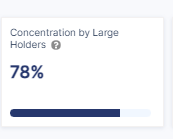
Into The Block shows that as of January 2024, 76% of circulating supply is held by large investors and whales.
Supply held by Large Investors
Shibarium
Shibarium is the blockchain developed by Shiba Inu’s team because the excessive gas fees in Ethereum were troubling its popularity. Further, with its own blockchain, the meme coin could finally offer some utility of its token. The absence of any utility seemed to make it redundant and the blockchain was losing its relevance.
The Shibarium blockchain was launched on August 16, 2023. However, it soon crashed because it witnessed 480 times more traffic than it could handle (16 Million visitors). This led to a crash in its website (and not the blockchain).
I want to make sure people understand that if https://t.co/K6OGCE01iv is down just the block explorer is down not the network, this is because we use an opensource version of Blockscout and don’t use big servers for it and they are working on getting hosted version up soon.…
A few days later, on Aug 21, 2023, the team restored the website with the help of Polygon’s team. Shytoshi Kusama, lead Shibarium developer, thanked Sandeep and his team at Polygon, acknowledging the help even in a cutthroat market.
#Note: During the same period (Aug 2023) companies operating in Web3 were still experiencing difficulties due to lack of funding, uncertainty of Bitcoin ETFs and several other market-related factors.
Need for Shibarium and its Benefits
The need for Shibarium was felt due to the following reasons:
High gas fees in Ethereum
Low utility of Shiba Inu Token
Lack of any value other than just being a meme coin
High developmental activity in other projects
Let me explain these topics one by one based on my real life experience with Shibarium.
1. High Gas Fees on Ethereum
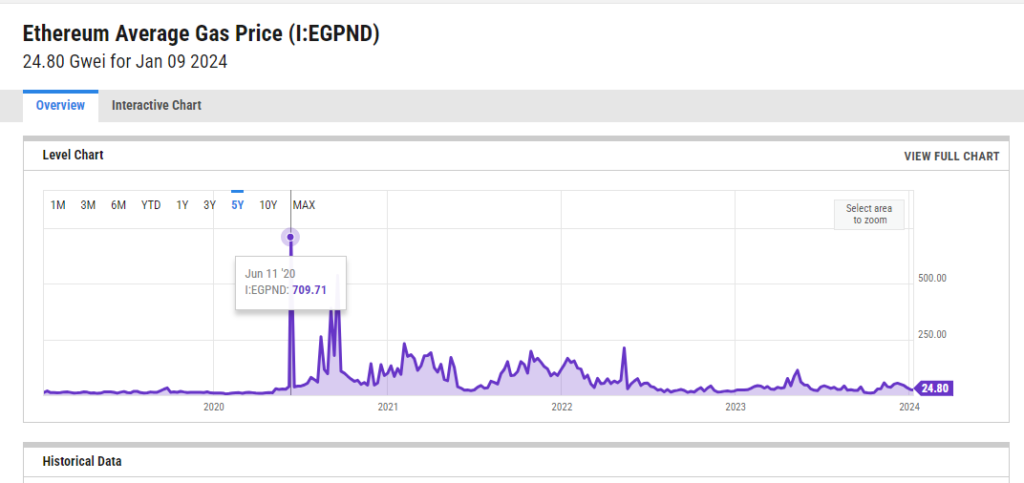
When I first started working in Web3, we used to receive payments in USDT (Ethereum). In early 2022, we found that the gas fees had skyrocketed to nearly $35 per transaction. However, by late 2022 I saw it had calmed down to about $5. Yet, this was also a very high price to pay and would kill the returns on my investments.
Ethereum Average Gas Fees in Gwei, 2018-2023
When I bought $10 worth of Shiba Inu, I was had to spend $5 just on gas fees. Obviously the $5 gas fees didn’t matter when your transaction was above $10,000. But for smaller buyers, it made no sense to pay such as high gas fee.
Since Shiba Inu was issued first on Ethereum as an ERC-20 coin, any buyer transferring those to their own wallet had to pay a steep gas fees.
For, other coins there were other blockchains available. For example, USDT was also issued on Tron (less than $1 fees). However, Shiba Inu was only available on Ethereum.
Also, when I used wrapped versions of Shiba Inu and stored them on BNB Chain, I saw that they had very less liquidity and often would take several minutes for buying or selling. This badly impacted my profitability.
2. Low Utility of Shiba Inu
The only reason Shiba Inu was popular because it had a huge fan following but fans were later disillusioned because all they could do with their Shiba Inu coins was to buy and store them. Unlike Ethereum it had no more utility like NFTs, DeFi or DApps.
The introduction of these featured on Ethereum would not have worked because it would keep many small investors away, which would violate the basic tenets of decentralization.
3. Value Proposition
The token had no other value proposition other than having a dynamic community. Clearly the utility of a community did not give users any real monetary benefit.
It prevented several users like me to buy it. The usual response that I would get is “Do we get more returns on investment if the community size increases?” Sadly, that was a no.
Therefore, launching its own blockchain made much more sense. Now community members could play games, buy NFTs, do DeFi activities and much more.
4. Competition
Several of its competitors started high developmental activity with their projects like Cardano, Polygon and Solana. By not doing anything on this front Shiba Inu risked losing relevancy and the tag of a top altcoin.
Top Projects with High Developmental Activity in Dec 2024, Source: CryptoDiffer.com
Why Create a Layer-2 and not a Layer-1 Blockchain?
A Layer-1 blockchain is a self centric and has no shared resources with any other blockchain. They are designed to be independent. A cryptocurrency developed in a Layer-1 blockchain cannot be transferred to other chains as they do not have the same developmental standards.
Layer-2 blockchains seek to support other layer-1 blockchains by validating their (L1’s) transactions off their blockchain. This is done by providing Zero Knowledge(ZK) Rollups or Optimistic(OP) Rollups. For example, Ethereum’s transactions could be validated on Polygon through ZK Rollups. They are very similar to the Layer-1s and are often based on the core of L1 blockchains.
Shiba Inu’s blockchain, Shibarium, was a Layer-2 blockchain of Ethereum.
The decision to develop a Layer-2 solution was due to several reasons as per my understanding and research.
Shiba Inu was issued on Ethereum and could facilitate an easy transfer of coins to Shibarium. Therefore, it had to be designed in a similar way as Ethereum.
Users using Ethereum’s DApps and DEXes could be incentivized to use Shibarium with no additional knowledge.
Shibarium could get some traffic and transactions from Ethereum as people would have seen a cheaper alternative to store their ERC-20 tokens and NFTs.
Success or Failure
Shibarium’s success depends on several factors such as user experience, integration with exchanges and various protocols, wallet integrations, etc.
Shibarium Wallets
Below is a list of wallets that support the Shibarium blockchain.
NOTE:
Exchange wallets are those which are integrated with any exchange and is used to buy, sell or store crypto. You cannot connect these wallets to individual websites or protocols.
Hot wallets are those which are available as a software for desktop, android or iOS device. They are also available as browser extensions.
Cold wallets are hardware wallets which can be disconnected from the internet (air-gapped) for security.
Shiba Inu burns a portion of those tokens which it receives as Gas Fees. There have been numerous spikes in burns and these massive token burns are also well received within the community.
Why burn Shiba Inu Tokens?
Burning of Shiba Inu decreases in the circulating supply. Since, the demand is same before and after burning, the value of circulating Shiba Inu tokens increases. This is as per the law of demand and supply.
When it was launched Shiba Inu had 1000 Trillion tokens in circulating supply which was reduced by 400 Billion by a generous burning by Vitalik Buterin.
Currently, the circulating supply is around 581 Trillion coins and an additional 8.2 Trillion coins have been locked via staking.
#NOTE: Staking reduces the token supply temporarily. While burning removes them permanently from circulation.
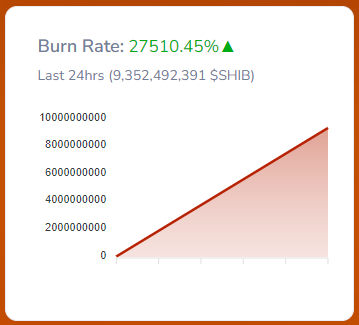
Lately as of Dec 2023 and Jan 2024, there have been numerous spikes in token burns aided by the transfer of Shiba Inu to Shibarium by Whales.
9 Billion Shiba Inu Burnt between Jan 9-10, 2024, Source: SHIBBURN
Shiba Inu Burn Addresses
Address Name
Burn Address
Burn Address 1
0xdead000000000000000042069420694206942069
Burn Address 2
0x000000000000000000000000000000000000dead
Black Hole Address / Null Address
0x0000000000000000000000000000000000000000
NOTE: A Black Hole Address sends the tokens to the Genesis Block from which the cryptocurrency was created.
Burning Targets
In a tweet, Shytoshi Kusama said in December 2023 that a 99.9% burn rate though challenging was not impossible.
Frequently Asked Questions
What is the benefit of Shibarium?
1. Shiba Inu’s own blockchain. 2. Cheaper and Faster transactions than Ethereum. 3. More utility with DApps, DEXes and DeFI. 4. NFT functionality.
Is Shibarium a wallet?
No, Shibarium is not a wallet. Popular wallets that support Shibarium are MetaMask, Trust, Binance, etc.
Can SHIB burn $100 trillion coins?
Yes, Shiba Inu’s lead developer Shytoshi Kusama has already teased the idea and said it was possible to even burn around 480 Trillion coins (99%).
Will Shiba Inu burn trillions of coins?
Yes, Shiba Inu’s lead developer Shytoshi Kusama has already teased the idea and said it was possible to even burn around 480 Trillion coins (99%). However, the actual burn might take more than 10 years even if it is done blazingly fast.
What happens in Shiba burns coins?
When Shiba Inu burns coins, the value of other coins increases based on the law of demand and supply.
Will Shibarium be a Success?
Yes, but that depends on several factors such as user experience, integration with exchanges and various protocols, wallet integrations, etc.
A blockchain is a set of blocks each of which records details of several transactions. Together, it creates a distributed ledger that is nearly immutable and is able to process transactions in a much efficient manner.
Blockchains issue cryptocurrencies which are can be transacted cheaply and almost instantly. This led to the creation of a new era of finance called as Decentralized Finance.
Table of Contents
History of Blockchains
Though blockchains existed since 1996 when Nick Szabo brought the concept of cryptocurrencies. However, then cryptocurrencies could not exist in a way that prevented double spending.
Why early cryptocurrencies met failure?
In early cryptocurrencies, anyone could copy them and spend them a number of times. This made it difficult to see whose transaction was original because every transaction was identical.
This problem was called as double spending.
Bitcoin Solves Double Spending
The first cryptocurrency which prevented double spending was Bitcoin. It solved the problem through an innovative method called proof of work. Each transaction was broadcasted to the entire network and was verified multiple times. Further, a copy of all transactions was available with everyone, which prevented fake transactions.
Working of Bitcoin’s Blockchain
The people who validated the transactions had to go through a complex process to obtain a value called Nonce, which was unique to each transaction. Since every verifier could obtain the Nonce value independently, they were able to see that a transaction was valid.
The transaction verifiers are paid a part of blockchain transaction fees. For proof of work blockchains, they are called as miners and for proof of stake blockchains they are known as validators.
Automation of Blockchains with Ethereum
The second generation of blockchain started when Ethereum was launched in 2015, its founder Vitalik Buterin and other co-founders added a feature called smart contracts which automated transactions. Now transactions need not to be initiated by humans, the blockchain was itself capable of doing so.
The application was seen in betting, auctioning, decentralized exchanges, liquidity pools, cryptocurrency swapping protocols and several other areas.
The Ethereum Blockchain
New Era of Cross-Chain Functionality
Even the second generation of blockchains could not transfer assets among each other.
This was solved with cross-chain transfers. Tokens were either locked or burnt on one blockchain and minted on the other. The value of tokens burnt on one chain were of the same value as those minted on the other chain.
This was possible for all kinds of tokens, whether fungible (cryptocurrencies) or non-fungible (NFTs).
Emergence of New Applications
After the maturing of blockchain technology by 2018, new trends emerged in blockchain which catered to data management (The Graph), Internet of Things (IOTA Chain), data transfers to and from blockchains (Chainlink) and non-traceable blockchains(Monero).
Trends which were till now suppressed due to reasons such as lack of adoption also re-emerged.
One such application was asset tokenization. This application made it possible to convert the ownership of real world assets like cars, land and property into blockchain tokens which made it possible to transfer them within record time (as compared to traditionally several weeks).
Blockchain Terminology
Atomic Swaps: These are cross-chain transfers between two addresses without the need of any centralized party. Asset is either locked or burnt on one chain and minted on another.
Coins: Those cryptocurrencies which exist on their own blockchain are called as coins. For example BTC on Bitcoin’s blockchain or ETH on Ethereum’s blockchain.
Consensus Mechanism: Consensus mechanism is a way through which multiple nodes in a blockchain agree that a certain transaction is valid or invalid.
Cryptocurrencies: These are assets on the blockchain which carry real monetary value. They can be converted in cash. These tokens are fungible which means they can be divided into small denominations (fungibility). For example, Bitcoin can be divided into 100 Million Satoshi, which is the smallest unit of a Bitcoin.
Difficulty: This is the numerical measure of complexity which is encountered while validating a blockchain transaction.
Finality: This is the step where blockchain transactions are permanently recorded in a block and few blocks have already passed. It ensures that a transaction is already final. Bitcoin’s finality is 6 blocks which means that after your transaction is added, 6 blocks should pass before receiver is able to use those funds.
Gas Fee: These are the transaction fees which are paid for transacting on the blockchain. Though initially meant for Ethereum transaction fees only, now it is a widely used term.
Gas Price: The price required to be paid to sign and initiate a transaction. In Ethereum, gas is calculated in terms of Gwei.
Gas Wars: A gas war is the auction for priority of keeping a transaction before everyone else. In blockchain, transactions are auctioned and bidders who are bidding higher fees are included first in a block.
Genesis Block: This is the first block of a blockchain and unlike other blocks it does not have any hash function of previous block since it is the very first one.
Halving: This is the schedule where Bitcoin’s rewards for miners reduced by half for each new block.
Hash: A hash is a data set that is obtained after processing earlier data in a way that the process is not possible backwards. For example, if the hash of data X creates data Y, the hash of data Y does not create data X.
Hash Rate: Hash Rate is the number of cryptographic hashes that can be done in one second.
Immutability: This is the blockchain feature which makes it almost impossible to change blockchain transactions after they are finalized.
Forks: A fork is a change in the blockchain. Hard forks are changes that make irreconcilable differences between the original and the new blockchains while soft forks are changes that do not impact the compatibility of original blockchains. No new blockchain is created as a result of soft fork.
Mainnet and Testnet: Mainnets are the main blockchain networks on which transactions occur while testnets are the functional replicas of mainnet used for testing of new blockchain features, tokens or Dapps.
Merkle Root: Merkle Root of a block is the hash result of all the transactions present in that block.
Merkle Tree: The pathway using which Merkle Root was generated is called the Merkle Block.
Mining: In proof of work blockchains the process of validating transactions and adding them to the blocks is known as mining.
NFTs: Non Fungible Tokens are those which cannot be divided. These are mostly assets which can be:
Text
Audio
Video
Image
Code
Software
Node: A node is a blockchain verifier that has full rights to add transactions to a blockchain. In a proof of work blockchain, these nodes are called as miners and in a proof of stake blockchain they are called as validators.
Nonce Value: The nonce value is a number which is obtained after hashing the transaction details and hash value of previous transaction in a block. Nonce values are unique for each transaction.
Oracles: Oracles are softwares that send information to blockchain smart contracts in a secure and verified manner. Examples are Chainlink, QED, etc. They can be either centralized or decentralized.
Orphan Block: Orphan blocks are those blocks which contain verified transactions but are not accepted in a blockchain because the transactions were already included in other blocks which were produced faster.
Optimistic Rollups: This is a mechanism where transaction data is written on an empty part of a block which was meant for storing metadata. Since writing metadata on blocks does not require validation, it costs cheaper than recording transactions in a blockchain. The transactions are written on a blockchain but in a cheaper way.
Private key: These are basically passkeys which allow you to send and receive cryptocurrencies. You can only send a cryptocurrency if you sign the transaction with your private key. If someone else accesses your private keys, they can access your funds, or even steal them.
Public Address: Also known as public key, this is the address on the blockchain using which you can receive cryptocurrencies. The public address is usually an alphanumeric string.
Ring Signature: A ring signature is a shared signature which is used to sign blockchain transactions. The ring signature could be used by anyone of the ring members.
Sharding: This is the process of dividing the single giant blockchain consensus network into numerous smaller ones which can process transactions independently. This increases the speed of the blockchains since each shard acts as an independent chain.
Smart Contract: A smart contract is a piece of code on a blockchain which can automate transactions based on a pre-determined instruction. For example, if a certain thing happens, pay X amount to someone.
Staking: This is the process of collateralizing cryptocurrencies so that you are given the right to validate transactions and earn rewards. Even if not validating transactions, anyone can stake their crypto to earn rewards indirectly (through a validator).
Tokens: Tokens are cryptocurrencies which are not on their own blockchain or might have no blockchain of their own. For example, USDT is a token on Ethereum’s Blockchain while ETH is a coin on Ethereum.
Token Standards: These are standardized protocols of creating new blockchain tokens which makes it possible for swapping with each other. For example USDT and USDC are stablecoins which both exist as ERC-20 tokens. ERC-20 is an Ethereum token standard.
Turing Complete: It means that a certain computer can execute any conceivable program or software. Ethereum is Turing Complete.
Wallet: A wallet is a software which stores your public addresses and private keys and lets you send and receive cryptocurrencies. For example: Lightning Network Wallet for Bitcoin.
Hot Wallet: These are wallets which exist as a software and are meant for easy access.
Cold Wallet: These are wallets which exist on hardware and are meant for secured storage.
Wrapped Tokens: These are tokens which locked in one chain and minted on another which makes it seem like they have been transferred across chains. For example, Bitcoin can be wrapped to create WBTC and transferred to Ethereum as an ERC-20 token.
Zero Knowledge Rollups: This is a mechanism which allows for the validation of a blockchain(L1) transaction outside of the blockchain (on another chain{L2}). At the end the summary of transaction is validated at once to see if there is any error.
How does a Blockchain Work?
All blockchains work basically in a similar way which starts with initiating a transaction, which is then verified and after that is finalized. The following stepwise process illustrates the working of a blockchain along with a flowchart.
Working of a Blockchain
A transaction is initiated by a user.
The transaction is broadcasted to all the nodes (verifiers).
Each node runs computations to verify the transaction.
Transactions are added to a block.
The newly added block is broadcasted to the network.
The block is finalized when a certain number of new blocks is added after it.
Hacking in Blockchain
Re-Entrancy Attack: In this attack, a function in the code is externally invoked which leads it to run multiple times in a single transaction. Hackers are able to repeat the same transfer of funds multiple times.
51% Attack: Blockchain transactions work on majority rule. If more than 51% of nodes are hacked, then the hacker can do whatever with other people’s balance. This was seen in the Axie Infinity Hack where 51% (11/21 nodes) were hacked by Lazarus Group and at the end resulted in a $625 million loss.
DAO Attack: On June 17, 2016 Ethereum was hacked and hackers were able to steal 3.6 million of the total 11.5 Million ETH. This lead to the creation of Ethereum Classic which opposed the rollback (hard fork).
Frontrunning: Frontrunning is the process of buying tokens before a buyer and then selling the tokens to that original buyer for a higher price.