
Tag: federal reserve

  • The US Federal Reserve Leaves Rates Unchanged at 4.37% in July 29-30 Meet
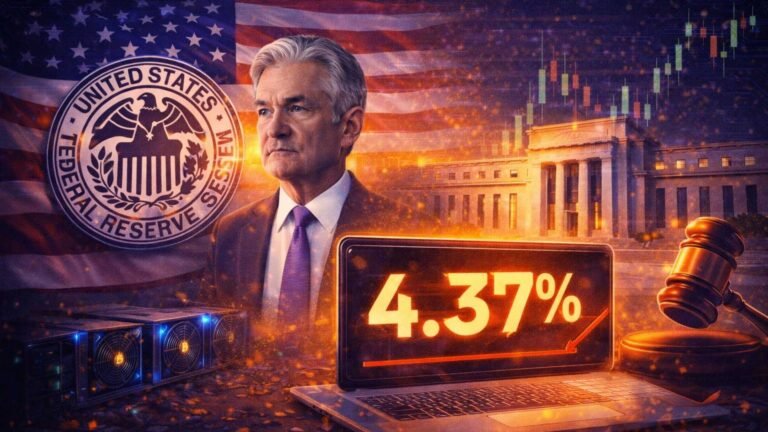
    • The US Federal Reserve has kept its interest rates unchanged for the current policy meeting.
    • Existing policy rates for repo and reverse repo are 4.25% to 4.50%.
    • Effective Federal Funds Rate at 4.37%.
    • High inflation at 2.7% in June is the main reason for keeping the rates unchanged.
    • All cryptocurrencies except Bitcoin and Ethereum have been facing a severe liquidity crisis.

    Policy Rates Unchanged at 4.37%

    The US Federal Reserve has kept interest rates unchanged for the fifth time this year after Fed meetings in March, April, June, and July 2025. The effective federal funds rate remains unchanged at 4.37% while the repo rate and reverse repo rate are in a window of 4.25% to 4.50%.

    The last Federal Reserve interest rate reduction of 0.25% happened in December 2024.

    The next Federal Reserve Meeting is on September 16-17, 2025, and will be the third-last meeting of the year. After September, there are two meetings scheduled on October 28-29 and December 9-10 this year.

    Why are Bitcoin and Ethereum Growing?

    Bitcoin and Ethereum have been growing due to increased demand from corporate sectors. Bitcoin has seen its demand surge in the ETF markets and from companies like Strategy, Metaplanet, and GameStop, while for Ethereum, the demand has been surging from technology companies like Golem, Bitmine, and others.

    Expectations from the Next Policy Meeting on September 16-17, 2025

    The US Federal Reserve in its January 2025 meeting indicated that there is a likelihood of only 2 rate cuts and a maximum of 0.5% in 2025 due to inflation expectations of 3% throughout the year. Till date, i.e., August 2025, the inflation figures have remained higher than 2.4% with the latest report of June showing a CPI (inflation) of 2.7%.

    All of these make it difficult for the US Fed to cut interest rates. The Fed has a mandate to keep inflation below 2% while ensuring there is proper growth in the job market. As the job market appears relatively stable, there is very little pressure on the US Federal Reserve.

    However, since the policy meeting of September will be one of the last 3 meetings in 2025, there is a chance of at least a 0.25% rate cut, given that Jerome Powell continues as the chairman. If Powell resigns, Donald Trump might be looking at a 3% rate cut within the first half of 2026.

  • US Fed Might Cut Rates by 0.25% As Inflation Cools to 2.4%

    • The US Consumer Prices Index (inflation) was at 2.4% against expectations of 2.6%.
    • A lower inflation was necessary for a rate cut in the May 6-7 FOMC meeting.
    • The US Federal Reserve is likely to go for at least a 0.25% rate cut.
    • Bitcoin might recover above $100k and Altcoin markets are expected to recover at least 30% to 50% following the rate cut.

    US Consumer Price Index at 2.4% vs Estimates of 2.6%

    The US Consumer Prices Index (inflation) for the month of March 2025 came at 2.4%, close to the 2% target of the US Federal Reserve. Markets estimated the inflation numbers to be at 2.6% for March 2025. Last month, in Feb 2025, the CPI came at 3.1%.

    Lower CPI numbers are critical for a rate cut because they signal a cooling inflation. A cooled-down inflation is a necessary precursor to avoid any hyperinflation (inflation above 10% in the USA) scenario.

    Since these inflation numbers for March 2025 were the last one before the US Fed FOMC meeting next month, it would prove critical for them to take a dovish way ahead (i.e., help to cut interest rates). An inflation of 3% or higher would have forced the US Fed to go for a delayed interest rate cut.

    Will the US Fed Cut Rates? How Much?

    The US Fed is most likely to cut interest rates at least by 0.25% and at max by 0.5%. If done, the effective Federal Funds rate would be around 5.12% (a window of 5% to 5.25%) from the current 5.37% (a window of 5.25% to 5.5%).

    The reason why we strongly believe in a rate cut ahead is because of the guidance provided by the US Fed in its March 18-19 meeting. The Fed said that starting from April 2025, it would begin quantitative easing, a term used to denote the act of a central bank to infuse liquidity (money) in an economy.

    Effect of US Federal Reserve’s Rate Cut

    This reduced federal funds rate would help lower interest rates on loans and discourage more people from saving which will help the dollars find their way into the economy.

    As a result, crypto and stock markets could see a major rally between 10% to 20%. This rally could give a major boost to the global economy in the short term amid a bitter US-led global tariff war.

    Relation Between US Fed Rates and Inflation

    In any economy, the role of setting monetary policy is played by the central bank of that country or economy, for example, the Federal Reserve System in the USA, the European Central Bank in the EU, and the Reserve Bank in India.

    A monetary policy basically maintains the supply of money in that country. If the money supply is too high, there would be high inflation whereas if it is too low, the economy would see a recession.

    To increase the monetary supply, the central bank lowers the interest rate and lends money at a cheaper rate to the banks. To reduce the monetary supply, it raises interest rates so that people save more with bonds and the loan interest rates also increase, which then sucks all the excess money from the economy.

    Main Roles of a Central Bank in an Economy with List of 5 Central Banks
    Main Roles of a Central Bank in an Economy with a List of Top 5 Central Banks

    In the US Economy, this role is played by the US Federal Reserve which makes interest rate decisions based on factors like economic activity, jobs data, inflation figures, and a few other numbers. Among them, inflation plays the largest role. The US Federal Reserve is supposed to keep inflation between 0% to 2%.