Tag: ethereum

  • Ethereum ETFs Trading at 25% Undervaluation

    The sole difference between holding Ethereum tokens and ETFs is that the latter does not give you staking benefits because anyone who buys Ethereum directly from crypto exchanges gets around 4% of staking rewards each year on top of token appreciation.

    As a result, Ethereum ETFs are seeing deep undervalued prices and currently, the US Ethereum ETFs are trading at a 25% undervaluation.

    Otherwise, Ethereum would have been the top altcoin ETF bringing in much-needed flows into its markets.

    Ethereum ETFs Are Extremely Undervalued

    Ethereum ETF Flows Since 17 March 2025
    Ethereum ETF Flows Since 17 March 2025

    In the last 14 days, Ethereum ETFs have seen a wild amount of inflows shrinking to $6.68 billion in market cap while their AUM is at $8.81 billion. This 25% undervaluation is a bit worrying because, in the broader markets, (both stock and crypto) high undervaluations signal an extremely bearish phase.

    Ethereum ETFs Need to Provide Staking Benefits or Risk it All

    Ethereum relies on a proof-of-stake consensus algorithm to secure its network. This means that the more people stake in Ethereum, the more secure it becomes. In return, the Ethereum blockchain offers rewards and newly minted tokens.

    In other words, staking simply gets you extra money and ETFs do not offer staking at this point. As a result, people do not wish to buy Ethereum ETFs.

    If the staking benefits are passed on to ETF buyers, then Ethereum ETFs could attract more buyers for the same reason why Bitcoin ETFs. To achieve that, the ETF issuers must file an amended ETF resubmission with the SEC.

    Ethereum Still Has Strongest Fundamentals

    Highest Liquidity

    With respect to the value of stablecoins on its chain, Ethereum has around $120 billion worth of stablecoins, beating the next largest one by a $50 billion margin.

    Stablecoins bring liquidity to the markets and are essential for investing and trading in any crypto.

    Ethereum Stablecoins vs Others in March 2025

    Highest Fee Revenue

    Ethereum collected the largest revenue in 2024 among all blockchains at $2.5 billion, around 16% higher than the second largest, Tron.

    Ethereum Leads in Revenue at $2.5 Bn in 2024, Highest Among all Chains
    Ethereum Leads in Revenue at $2.5 Bn in 2024, Highest Among all Chains

    Will Trump Alter ETF Terms via SEC?

    Trump is a DeFi millionaire himself (after NFTs, $TRUMP, $MELANIA, and his son’s WLFI), and it is likely that he might have considered this path. However, as a Trump observer since 2016, I expect him to act when Ethereum is at its lowest and he himself has set his own position right (through Derivatives or Spot buying).

    To pass staking rewards to the ETF buyers, the SEC’s nod remains a critical step. With pro-crypto candidate Paul Atkins’s takeover, we expect this task to end soon.

    Frequently Asked Questions

    How many Ethereum ETFs are there?

    There are 17 Ethereum ETFs, out of which 13 are in the USA. These 17 ETFs are:
    1. iShares Ethereum Trust
    2. 21Shares Core Ethereum ETF
    3. Fidelity Ethereum Fund
    4. Grayscale Ethereum Trust ETF
    5. Franklin Ethereum Fund
    6. Direxion
    7. Proshares Ethereum ETF
    8. WidomTree Investments Ethereum ETF
    9. Van Eck Ethereum ETF
    10. Bitwise Ethereum ETH
    11. Ark 21 Shares Active Bitcoin Ethereum Strategy Fund
    12. Coinshares Valkyrie Bitcoin and Ether Strategy ETF
    13. CoinShares International Ethereum ETF
    14. Invesco Galaxy Ethereum ETF
    15. Grayscale Ethereum Mini Trust ETF
    16. ARK 21Shares Active Ethereum Futures Strategy ETF
    17. 21S AFTM

  • Data Proves Ethereum Is The Real Market Leader

    Ethereum has been behaving irrationally despite having the following things to its advantage.

    Ethereum had the highest blockchain revenue in 2024 ($2.5 billion), beating all other cryptocurrencies like Tron, Bitcoin, and Solana.

    Top 6 Blockchains wrt Fee Earned

    The number of dApps on Ethereum is far greater than the number of dApps on other chains like Solana but comparable to BNB.

    Top 6 Blockchains wrt dApps

    Ethereum’s TVL is at $50.8 billion, about 700% higher than the nearest competitor i.e., Solana ($2.5 billion).

    The amount of liquidity that exists on Ethereum is also far greater than other blockchains at $120 billion. Comparatively, Tron has $62 billion of stablecoins and Solana at $11.5 billion.

    Why is Ethereum Not The #1 Crypto?

    Ethereum should have been the largest cryptocurrency but is way behind Bitcoin at a fraction of its price. There are some rational reasons like corporate support for Bitcoin (which companies thought as the Digital Gold). But there are a few irrational factors too, like Attention Economics.

    The Grayscale Ethereum Trust

    Grayscale Ethereum ETF Net Flows
    Grayscale Ethereum ETF Net Flows Since Launch

    Ethereum’s price has been under selling pressure since the ETF approval. Unlike the Bitcoin ETF, Ethereum ETFs saw wide selling due to one major factor.

    The Grayscale Ethereum Trust had amassed $2 billion worth of investments through the sale of its shares. It had a very high fee of 2.5%, which was 10x higher than the fees charged by Ethereum ETFs like BlackRock’s ETHA. As a result, those who had bought Grayscale Trust sold their shares.

    This led to a series of redemptions at a point when Ethereum had just touched a high of $4000. Seeing a shorting opportunity based on the Grayscale ETF induced sell-off, crypto markets saw a deep correction in Ethereum, plunging it to $3000 levels in no time.

    Disconnect With the Crypto Market Sentiments

    Another major reason why Ethereum faced a serious price challenge was its disconnect with the aspirations of broader crypto markets.

    To be honest, most first-time crypto users (who form the bulk of the markets) have just entered it to make big profits. For them, cryptocurrencies like Ethereum, Polygon, Arbitrum, or Algorand made little sense. This is why most of them moved towards memecoins, and later towards PumpFun (memecoin creation tool on Solana) to launch their own tokens. This phenomenon is termed as Attention Economics.

    Bitcoin had corporate support via ETFs, which was absent in the case of Ethereum. Still, today, most long-term Bitcoin ETF holders are corporate investors who bought them because they cannot show Bitcoin in their balance sheets.

    Lately, as these memecoin buyers exit the markets, the attention is expected to shift towards utility-driven projects like Ethereum once again.

    Exploring Rationality in Irrational Markets

    The worst thing about irrational markets is that they tend to correct when you least expect them to be.

    In the current markets, Ethereum could have been the largest blockchain if we think in rational terms.

    • It has a much wider application than Bitcoin.
    • It has a much larger DeFi TVL than Solana.
    • It has a much more sophisticated and well-tested smart contract technology than Cardano.
    • It has a much higher blockchain revenue than Tron.
    • It has a much higher validator count than all Layer-2s combined.
    • It has reduced its blockchain fees by 95% compared to the pre-Dencun Era.

    Clearly, Ethereum should be the top blockchain when it comes to deploying dApps

    To Invest or Not to Invest

    Ethereum’s long-term prospects are very strong, whether it be its blockchain revenue, user activity, on-chain dapps, DeFi TVL, liquidity metrics, or tokenomics. All indicate that the current status of Ethereum is at its strongest point.

    Media brands several blockchains as “Ethereum-killer”, yet none of them can consistently defeat it in any major metric, be it user growth, revenue, or on-chain TVL.

    Disclaimer: The above report has been made from an informational point of view and is not financial advice. Viewers are advised to seek financial advice before investing.

  • What is a Gas War?

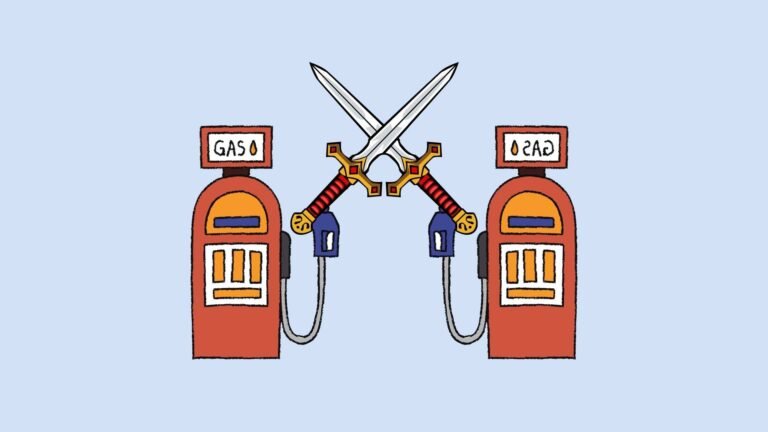
    In Ethereum, Gas War means a competitive situation where senders compete for gas fee to get their transactions executed in priority. Since, Ethereum transactions are auctioned to the highest bidder, the bidding results in spiraling up of bids which eventually results in a unsustainable gas price.
    Why Gas Wars Take Place?

    Ethereum never worked earlier on increasing its transactions speed because it thought doing so might reduce the security of the blockchain.

    This caused its transaction speed to remain stagnant at 10-15 TPS.

    However, this could not match the growing demand of the time and soon people had to wait un queue to get their transactions executed. Those who paid a higher fees got their transactions executed first.

    The only reason why Gas Fees are still high because most users prefer Ethereum for its security.

    During times of increased demand for transactions such as during airdrops, during NFT minting, or launch of popular DApps, the competition for gas increased to become Gas Wars.

    Need of Gas in Ethereum

    In the Ethereum Blockchain, gas is used to estimate the amount of work done by validators to verify transactions. The higher the work needed, the higher will be gas fees.

    Work is required to execute operations such as sending transactions, deploying smart contracts, or interacting with decentralized applications (DApps).

    For example, NFT transactions need higher work to validate them and therefore have a higher gas fees than Ethereum.

    Gas Fee Comparison in Ethereum
    Gas Fee Comparison in Ethereum

    What is Ethereum doing to avoid Gas Wars?

    Gas wars present a brutal scenario where small transactions are not economically viable because several times the transacted value is much lesser than the gas fees.

    Therefore, to reduce Gas fee, users use two methods to decrease transaction costs. They are Zero Knowledge Rollups and Optimistic Rollups. Both these processes rely on off-chain work which might compromise Ethereum’s security.

    Ethereum has also currently implemented a third way called Proto-Dank Sharding which helps reduce its dependency on other blockchains.

    Zero Knowledge Rollups

    Though Ethereum has not done much until 2024 for decreasing pressure on Gas Fees, other blockchains presented them as Layer-2 scaling solutions and helped offload the pressure on Ethereum by validating Ethereum transactions out of the Ethereum blockchains and submitting a summary of these transactions.

    When the summary is found to be true, all the transactions are also validated at the same time because the final state of the blockchain after the transactions is as expected.

    The entire process is known as Zero Knowledge Rollup because only the summary of transactions are kept and individual transaction details do not exist on Ethereum and it has no knowledge of the off-chain (Layer-2) transactions.

    Optimistic Rollups

    Optimistic Rollups also summarize transactions and only submit a summary of them for validation by Ethereum. But, there is a small difference between Zero Knowledge and Optimistic Rollups.

    Optimistic Rollups use call-data where the individual transactions (of the summary) are written. Call data is a space on the Ethereum block which is not validated by validators.

    This process decreases the transaction costs but also makes the blocks bulky because all the individual transaction data is still present inside the block.

    Proto-Dank Sharding

    Proto-Dank Sharding is a process where a feature called a “Blob” is attached to each block and this blob stores all the individual transaction data. The blobs do not make Ethereum blocks heavy because each blob in a block is deleted after 3 months of creation.

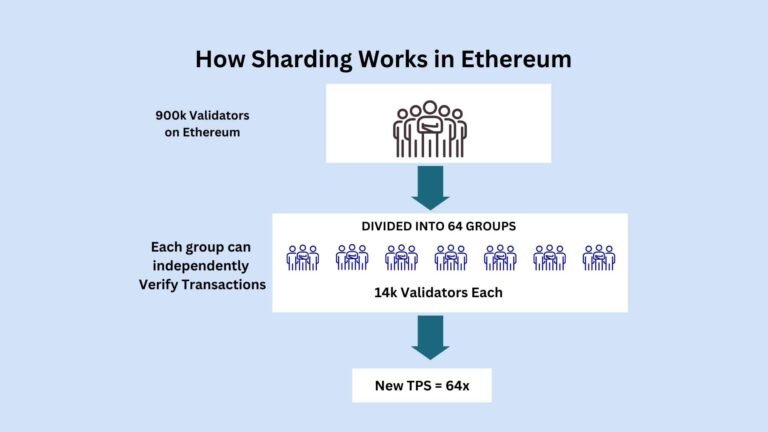
    This is different than Sharding which aims to increase the speed of Ethereum by dividing its 900k validators in to smaller groups each of which can independently verify transactions and add blocks to Ethereum.

  • What is Sharding in Blockchain?

    Sharding is the process of breaking a blockchain’s consensus mechanism(total no. of validators) into smaller units called “Shards”. Each shard has its own unique set of validators. This increases the capacity of a blockchain by the same multiple as the number of shards.

    Listen to this article as an Audio Podcast.

    Definition of Sharding

    Sharding can be defined as dividing the entire set of validators of the blockchain into smaller units. These smaller units are called as shards. Each shard has its own unique set of validators.

    The Need for Sharding

    The current methods of scaling poses the risk of off-chain tampering in ZK rollups as well as inclusion of undetected tampering in OP rollups.

    Currently, these two scaling methods are at work to scale Ethereum.

    • Scaling methods like Optimistic Rollups use call-data to store transaction records on Ethereum blocks. Call data is a empty space in a block that is not verified through consensus mechanism. However it makes the block heavier.
    • Zero Knowledge Rollups, another scaling solution verifies transactions on a second blockchain and stores the summary of these transactions as a single transaction on Ethereum. If the final state change after the transaction is as expected, the summary is considered as valid.

    However, these methods are not the final solution as Ethereum will forever depend on them to scale up. Also there is a possibility that someday one of them might ultimately replace ethereum.

    Also, the number of validators on Ethereum (more than 900k) will not be efficiently utilized. Dividing them into independent groups make much more sense as blockchains even with small groups work fine in Proof of Stake systems.

    1. Algorand has 110 validators
    2. Shibarium has 100 slots for validators
    3. Polygon has 100 validators

    How Sharding Works?

    In a blockchain, consensus is achieved after all or maximum number of validators verify the transaction.

    How Sharding is supposed to work in Ethereum
    Sharding in Ethereum

    Now, for big blockchains, like Ethereum, which has over 900k validators, running each transaction through all the validators does not make much sense. Blockchains can be even secured with lesser number of validators.

    So, what sharding proposes is dividing these 900k validators into 64 groups (via the Danksharding Proposal). Each group will have more than 14k validators which is enough to secure transactions and prevent 51% attacks.

    Since each shard will be able to act independently, each of them can add blocks to the blockchain. Therefore, now the speed of Ethereum can be 64 times higher (theoretically) than the current speed of 10-15 transactions per second.

    Sharding vs Proto-Dank Sharding

    In sharding the total no of validators are divided into independent groups each of which is able to add blocks to the blockchain.

    However, this is not easy to implement in Ethereum considering its security and size. Therefore, the Ethereum Improvement Proposal (EIP-4844) seeks to implement another technique called as proto-dank sharding.

    Proto Dank Sharding

    Proto-Dank sharding is the implementation of Sharding on the Ethereum blockchain but in a way which is feasible right now.

    It was named after two Ethereum researchers Protolambda and Dankrad Feist.

    It proposes to add “blobs” to the Ethereum blocks which can store transactions similar to call data in optimistic rollups. Unlike call data which stays on the blockchain forever, these blobs can be deleted after 3 months which is enough for finality of transactions.

    Since, they are not processed by the EVM, their

    The current number of validators are not split in Proto-Dank sharding.