Tag: bitcoin

  • Bitcoin Runes Might Outperform Bitcoin Ordinals in 2024

    Bitcoin Runes, another token standard coming out of the Bitcoin network (after BRC-20) has hit the market on 20th April 2023 just at the time of Bitcoin halving. Runes were created by Casey Rodarmor (creator of Bitcoin ordinals) and are based on the Ordinals Theory.

    The protocol helps in the creation and management of memecoins and degens in a way similar to Solana.

    How Bitcoin Ordinals Helped Create Surge in Bitcoin Miner Revenues?

    After the introduction of Bitcoin Ordinals, we saw a huge interest in them from the crypto community. Introduced in December 2022, Ordinals saw a huge boost near May 2023. The number of inscriptions (creation of Ordinals) touched as high as 400k per day.

    The creation of each ordinal was done by inscribing information onto a Satoshi, which was the smallest unit of Bitcoin (1 Bitcoin = 100 million Satoshis).

    Consequently, there was also a boost in the fees paid. Each Ordinals was basically created on a single Satoshi but their transaction fees was similar to transferring ordinary Bitcoins because both of them introduce similar changes in the Bitcoin blockchain.

    Note: Fees in blockchains are calculated based on how much data you are adding to the blockchain.

    Let us simplify it with an hypothetical example. Assume that for the transfer of 1 Bitcoin, it consumes 100 MB of data, and costs $10. So for the transfer of 1 Satoshi it would require 1 byte of data, and a fee of $0.00001. However, since a ordinal is created with adding more data onto a Satoshi, its size increases, to say 10 MB. Hence, the fees could be around $1 (1/10th of Bitcoin in size). But the Satoshi still remains a Satoshi, its value is the same but its transfer fee has increased 10 million times.

    This is how the fee has increased after the introduction of Ordinals.

    Decoding Miner Revenue Increase Due to Ordinals

    Now an increased fee would also mean an increase in miner revenues as each Bitcoin Ordinal would have to go through the verification process similar to an ordinary transaction.

    All in all, Bitcoin Ordinals helped miners make approximately $451 million in just fees. Also the value of miner stocks went up by 100%-300%.

    Will the Same Story Repeat for Bitcoin Runes?

    Yes, let me explain why. Casey Rodarmor has created Bitcoin Runes to help developers create memecoins which are easier to create, deploy and manage.

    We expect Bitcoin Runes to have a similar or even a stronger performance than Bitcoin Ordinals. The reason is due to the high demand in the Memecoin markets.

    Lately, memecoins have been the largest gainers in the crypto markets. Traditional memecoins like Dogecoin and Shiba Inu, have been trading at nearly 2x-3x prices as compared to the past year. New memecoins like Bonk, Pepe, dogwifhat and many others have also garnered massive number of users.

    The combined net worth of all memecoins stands at $56.8 billion as of 24th April 2024.

    Source CoinMarketCap
    Source: CoinMarketCap

    Now, if the same cryptocurrencies will be created on Bitcoin, they could fetch far more users than any other blockchain. The unmatched security of Bitcoin Network would make these cryptocurrencies more safe than other blockchain.

    Runes vs Ordinals

    Bitcoin Ordinals which were first seen in December 22, 2023 were intended to bring NFT like capabilities to the Bitcoin blockchain. They were created by Casey Rodarmor and used unspent UTXOs to create new cryptocurrencies.

    On the other hand Bitcoin Ordinals are Satoshis on which information is inscribed.

    Detailed Article on Bitcoin Runes: What are Bitcoin Runes? How Do They Work?

  • What are Bitcoin Runes? How Do They Work?

    Bitcoin Runes are a new token standard for the Bitcoin blockchain that helps create new cryptocurrencies from the UTXOs left after transactions. The token standard is an improvement over BRC-20 which is based on Ordinal Theory.

    Bitcoin Runes were launched with the 840,000th block on the Bitcoin blockchain which also marked the 4th Bitcoin Halving.

    Please note that Bitcoin Runes are different from BRC-20 tokens standards which were dependent on the Ordinals Theory and rely on the Taproot Upgrade.

    Casey Rodarmor’s Motive Behind Runes

    The main motive of creating Bitcoin Runes was that it was an upgrade over the BRC-20 protocol. Also, runes severely help in the management of UTXOs which earlier went to junk.

    Casey launched Bitcoin Runes with the 840,000th block in the Bitcoin blockchain which was the last block of the previous halving cycle and executed the 4th Bitcoin Halving. The work on Bitcoin Runes was started as far as September 2023.

    Casey Rodarmor who was behind the creation of Bitcoin Ordinals based on the Ordinal Theory.

    How do Bitcoin Runes Work?

    Bitcoin Runes are created as a result of Unspent Transaction Outputs (UTXOs). These are the “change” that gets left behind when a certain transaction is successful. Think of it as the $2 note you get back when you buy something worth $18 and pay with a $20 note.

    When a transaction is initiated, you typically send an entire UTXO to pay for the network fees. Now a portion of this UTXO is spent and a new UTXO is sent back to you. Runes are made when the original UTXO is marked with the Rune’s name, Symbol, Decimals and Total Supply.

    Then an OP_RETURN function gives the output which is in the form of Runes.

    Previously sent UTXOs were almost useless and had no further use.

    Technical Details about Bitcoin Runes

    Basic Concepts:

    • Rune ID: This is a numeric identifier unique to each Rune.
    • Output: In the context of a transaction, this refers to the specific place where Rune tokens are directed.
    • Amount: This specifies how many Rune tokens are being transferred.

    Transaction Mechanics:

    • OP_RETURN Output: Every action involving Runes—whether creating new ones or transferring existing ones—is recorded using an OP_RETURN output in a Bitcoin transaction. This output includes necessary information like the rune’s divisibility, name, and other metadata. Casey Rodarmor went to call Runes as simple OP_RETURN thing.
    • Divisibility: Each Rune can be split into smaller parts, up to 38 decimal places. For example, a typical divisibility setting might be 18 decimal places, similar to many Ethereum-based ERC-20 tokens.
    • Max Supply: The total amount of Rune tokens is capped and represented by a 128-bit unsigned integer. The maximum value is extraordinarily large, allowing for a vast quantity of tokens when considered with their divisibility.

    UTXO and Token Tracking:

    • UTXO (Unspent Transaction Output): The Rune protocol uses this Bitcoin mechanism to manage the supply of tokens. Unlike systems that link tokens directly to wallet addresses, Runes maintains its token supply within individual UTXOs. This means each UTXO contains information about the quantity of Runes it represents, independent of any wallet address.
    • Token Transfer: To move Runes, a transaction with an OP_RETURN output specifies how tokens are transferred from one UTXO to another. This system ensures the balance of tokens can be tracked across transactions without associating them directly with the personal identities of users.

    How are Bitcoin Runes Created?

    Runes are Created with Runestones.

    Bitcoin Runes are created when a message is inserted in the genesis UTXO that the resultant UTXO is to be converted into a RUNE. This message is called “Runestone”.

    Runestones are Etched on a UTXO

    The act of inserting a message into a runestone is called as “ETCHING”. Typically an “etching” contains the following information:

    • Name: A name must contain letters between 1 and 28 characters. For example, XAEADD is a rune’s name. 
    • Divisibility: Divisibility is the number of units a rune can be divided into. 
    • Symbol: This is the symbol of a Rune. Note: Runes without a symbol are given the generic scarab (`¤`) as their sign.
    • Premine: A premine is the initial allocated amount of runes set aside by its creator.
    • Terms: Terms established during an open mint allow anyone to mint and allocate units.
    • Cap: This factor decides how many times the Rune can be minted.
    • Amount: This value decides how many rune units (a fixed amount) will be created with each mint transaction.
    • Start height: This is the block height where the minting of the Rune will start.
    • End height: This is the block height where the minting of a Rune will end.

    Bitcoin Runes vs BRC-20

    Bitcoin Runes are far more efficient and feature rich as compared to the BRC-20 token standard.

    BRC-20 Tokens were created by DOMO.

    Wallets

    • Bitcoin Runes do not need any special wallet and are also compatible with layer-2 solutions such as the Lightning Network.
    • BRC-20 need wallet that are compatible with the Taproot Upgrade.

    Unspent Transaction Outputs (UTXO)

    • Bitcoin Runes do not create any UTXO, each UTXO can be further converted into more Runes. Also a single UTXO can be converted into multiple new runes such as 10 units of Rune A, 20 units of Rune B, 50 units of Rune C and so on.
    • BRC-20 Tokens do create UTXOs which go to junk.

    Data Storage

    • Bitcoin Runes use the main Bitcoin blockchain to store data and do not need any off-chain or third party storage.
    • BRC-20 coins do need an off-chain storage.

    Lightning Network Compatibility

    • Bitcoin Runes are compatible with Lightning network.
    • BRC-20 tokens are not compatible with the Lightning network.

    Frequently Asked Questions

    Were Bitcoin Runes a part of the Bitcoin Blockchain initially?

    No, Satoshi Nakamoto never thought that individual sats could be turned into runes. Runes were never a part of Bitcoin originally. However, sats on which the Runes are based, have been the fundamental unit of Bitcoin always.

  • The 4th Bitcoin Halving Completes, What Now?

    On 20th April 2024, UTC 12:09 am, the Bitcoin network reached a block height of 840,000 and this triggered the Bitcoin Halving event. This reduced the Bitcoin block rewards from 6.25 Bitcoins per block to 3.125 Bitcoins per block. However, there was also a four fold increase in Bitcoin’s block rewards as compared to the third halving event.

    Now that the Bitcoin Halving event has completed. Its finally time to assess what lies ahead now. Turbulent markets, macroeconomics and troubled geopolitics seem to present a lot of challenges ahead.

    Facts About The 4th Bitcoin Halving

    • Old Block Reward was 6.25 BTC per block.
    • New Block Reward at 3.125 BTC per block.
    • Timestamp for the 840,000th block was 12:09 am UTC on 20th April 2024.
    • Price of Bitcoin at halving was $63,984.
    • Next (fifth) estimated Bitcoin halving date between Feb 4th and April 17th, 2028.

    Now that the fourth Bitcoin Halving has finally completed, its time to take a look at what happened and assess what lies ahead.

    The halving event took place at 12:09 am UTC on Saturday 20th April 2024 (19th April for the Americas).

    The new block rewards is at 3.125 Bitcoins per block as compared to the old block reward at 6.25 Bitcoins per block. However, there is an increased payout. At the 3rd Bitcoin halving, the price of Bitcoin was at $8618 which means a block reward was valued at $53,862(6.25 BTC x $8618). This increased to over $200k (3.125 BTC x $63,984) after the 4th Bitcoin halving.

    Bitcoin’s Price to Get 3 Setbacks After The Halving

    First Setback: Miners Selling Bitcoins

    It is expected that around $5 billion worth of Bitcoins might be sold by the miners. The Bitcoin miners have been sitting at their miner rewards since quite a long time. Now that block rewards are half (3.125 BTC per block), some of them might be forced to sell their Bitcoin holdings.

    As per 10x Research this selling might keep Bitcoin under pressure for the next 6 months.

    Second Setback: US Government Selling $2 Billion worth Bitcoins

    Another seller who is ready to sell their Bitcoins is the US Government which is estimated to hold roughly $14.7 billion in cryptocurrencies. Out of this, approximately $2 billion worth of Bitcoins have already been moved to Coinbase on 2nd April 2024 for selling in the open market.

    As per Arkham Intelligence, the government funds were those which were seized from Silk Road, a darknet website founded by Ross Ulbricht (now jailed).

    Third Setback: ETF Outflows

    A third setback would be the slowdown in the Spot ETF inflows. Since, their launch, spot ETFs have seen very generous inflows to the tune of $300 million per day. The highest halving recorded till date was on 12th April 2024 when Bitcoin’s price achieved its first all time high in 2024 (previous one was on November 10, 2021).

    However, the inflows had stopped prior to the having. You can see the chart below to get an idea of Spot ETF inflows and outflows.

    Bitcoin Spot ETF Flows, Coinglass.com
    Bitcoin Spot ETF Flows, Coinglass.com

    Bad Macroeconomics to Hurt Bitcoin

    The US Federal Reserve has clearly suggested that they might not cut interest rates in their next meetings. Fed Chairman Jerome Powell said that the recent readings in US inflation was hotter than expected and this would make it difficult to cut rates in the near future.

    Also pointing towards the recent growth data, he said that there were not sufficient steps taken towards achieving the 2% inflation target. Clearly by steps, he meant there could be more rate cuts or neutral policy decisions in the next few FED meetings.

    Currently, the US inflation rate is at 3.5%.

    The dependence on US inflation and interest rates lies because most of the Bitcoin buyers hail from the USA. Also, the US Spot Bitcoin ETFs far outweigh their global competitors in Assets Under Management (AUM).

    Geopolitical Tensions Might Cease Soon

    The Iran-Israel conflict seems to have ended for now. The conflict was a major cause of Bitcoin’s fall in price from $65k to $60k a few days ago.

    Wars and conflicts typically serve to reduce the market’s appetite for fresh buying.

    Fifth Bitcoin Halving Estimated Between 4th Feb 2028 and 17th April 2028

    The next Bitcoin halving which will further decrease block rewards from 3.125 BTC to 1.5625 BTC is expected to happen between the 4th of February 2028 and 17th of April 2028. This is considering the average time between Bitcoin blocks to be between 9.5 to 10 minutes.

    Price Analysis

    Bitcoin Daily Charts as on 20 April 2024
    Bitcoin Daily Charts as on 20 April 2024

    After touching a low of $60k, Bitcoin has now bounced back taking $61k as its new support zone. However, there is a resistance near $73.2k.

    A move above $73.2k would signal a price rally towards $80k followed by $100k. However, we expect the second target of $100k only to materialize towards the end of the second half (Nov-Dec) of 2024.

    A move below $61k would signal a breakdown in prices and Bitcoin might move rapidly towards $50k-$52k which would be a strong buying zone and hence a strong support.

    Disclaimer: This analysis is for educational purposes and should not be considered trading advice.

    FAQ

    What is Bitcoin Halving, How does it Work?

    Bitcoin Halving is the event that reduces the Bitcoin block rewards to half every four years. Previous halvings were in 2012, 2016, 2020 and 2024. The latest one in 2024 reduced the Bitcoin block rewards from 6.25 BTC per block to 3.125 BTC per block. This is done to increase the scarcity of Bitcoins.

    What does Bitcoin Halving mean for investors?

    For investors, Bitcoin halving means profit, as the value of their Bitcoins will increase due to scarcity. Also, it has been observed that a year after every halving, Bitcoin has given phenomenal results to its investors.

  • Is Bitcoin Mining Still Profitable in 2024? India-based Case Study

    • Bitcoin Mining is still profitable with large professional grade miners.
    • Bitmai’s New Antminer S21 pro could help achieve a break even within a year.
    • After the Bitcoin Halving, a decline in profit will only occur if Bitcoin does not cross $100k.

    Even with all the criticisms, Proof of Work still remains one of the most secure and rewarding consensus mechanism in 2024. With Bitcoin Halving approaching around the 18th of April 2024, one question strikes all minds – Is Bitcoin Mining still Profitable?

    The Answer is yes. If you are using a professional grade mining hardware such as the Antminer S21 (200 Th/s), you would still manage to earn $21 (with electricity cost $16). With latest miners costing around $18.9/Th (Bitmain Antminer S21 Pro), it would barely take you three months to recover your initial setup cost.

    Cost of Bitcoin Mining with Antminer S21 Pro in India

    One of the most advanced Bitcoin miner from Bitmain, i.e., Antminer S21 Pro has efficiency of 15 J/Th and it can mine Bitcoin at a rate of 250 Th/s. The power consumed by the machine comes around 3000W.

    If you consider electricity cost in my region(in Odisha, India), it would cost me somewhere around $0.06 per kWh(unit of electricity). That helps me earn around $16 a day or $500 roughly per month.

    With the latest Bitmain Antminer costing around $4,725, take an additional 18% as taxes, it would roughly be around $5575.

    Note: You could adjust rates according to your region, taxes and cost of electricity and calculate the profitability of your Bitcoin mining setup.

    Effect of the Bitcoin Halving

    Although the halving will reduce Bitcoin’s block rewards to 3.125 BTC per block, still with the expected rise in Bitcoin’s price post-halving, miners would still be profitable.

    With my experience, I estimated same levels of profitability if Bitcoin crosses $100k. Several experts have already signalled that Bitcoin would cross this price levels within H1 of 2022.

    Also if the Macro Diagonal Theory proves correct, this price might be achieved by June 2024.

    Disclaimer: This post is not a promotional post for Antminer. This study has been done with Antminer S21 Pro as an example.

  • Is Bitcoin Mining Still Profitable in 2024? India-based Case Study

    • Bitcoin Mining is still profitable with large professional grade miners.
    • Bitmai’s New Antminer S21 pro could help achieve a break even within a year.
    • After the Bitcoin Halving, a decline in profit will only occur if Bitcoin does not cross $100k.

    Even with all the criticisms, Proof of Work still remains one of the most secure and rewarding consensus mechanism in 2024. With Bitcoin Halving approaching around the 18th of April 2024, one question strikes all minds – Is Bitcoin Mining still Profitable?

    The Answer is yes. If you are using a professional grade mining hardware such as the Antminer S21 (200 Th/s), you would still manage to earn $21 (with electricity cost $16). With latest miners costing around $18.9/Th (Bitmain Antminer S21 Pro), it would barely take you three months to recover your initial setup cost.

    Cost of Bitcoin Mining with Antminer S21 Pro in India

    One of the most advanced Bitcoin miner from Bitmain, i.e., Antminer S21 Pro has efficiency of 15 J/Th and it can mine Bitcoin at a rate of 250 Th/s. The power consumed by the machine comes around 3000W.

    If you consider electricity cost in my region(in Odisha, India), it would cost me somewhere around $0.06 per kWh(unit of electricity). That helps me earn around $16 a day or $500 roughly per month.

    With the latest Bitmain Antminer costing around $4,725, take an additional 18% as taxes, it would roughly be around $5575.

    Note: You could adjust rates according to your region, taxes and cost of electricity and calculate the profitability of your Bitcoin mining setup.

    Effect of the Bitcoin Halving

    Although the halving will reduce Bitcoin’s block rewards to 3.125 BTC per block, still with the expected rise in Bitcoin’s price post-halving, miners would still be profitable.

    With my experience, I estimated same levels of profitability if Bitcoin crosses $100k. Several experts have already signalled that Bitcoin would cross this price levels within H1 of 2022.

    Also if the Macro Diagonal Theory proves correct, this price might be achieved by June 2024.

    Disclaimer: This post is not a promotional post for Antminer. This study has been done with Antminer S21 Pro as an example.

  • Bitcoin Falls Due to $1.6bn GBTC Selling by FTX

    Bitcoin has witnessed a selling pressure after the ETFs were approved on the10th of January 2024. The cryptocurrency made a high of $48,939 on 11 Jan 2024 after the ETF approval. The price then fell to $38,521 on 23 Jan 2024 witnessing a sell-off which was accompanied with rumors of profit booking.

    FTX Sells $1.6 Billion GBTC Shares due to Bankruptcy

    Bitcoin Price from 24 Dec 2023 24 Jan 2024
    Bitcoin Price from 24 Dec 2023 24 Jan 2024

    Although, there was a bit of profit booking taking place in the market, yet, the main reason we found was that FTX sold nearly $1.6 billion worth of Grayscale Bitcoin Trust (GBTC) shares. Since the shares were redeemed by FTX, the Bitcoin in those shares had to be sold off which cost the market to fall.

    In total, GBTC saw outflows of about $2 billion out of which, FTX alone sold $1.6 billion worth of shares. The bankruptcy of the FTX made it compulsory for it to sell those shares to pay its debtors which sold 22.28 million shares were sold via Mirax Capital.

    Grayscale Bitcoin ETF became the largest one after the Grayscale Bitcoin Trust was allowed by the SEC to convert it into an ETF. At the time of the conversion, the net value of assets under management were $28.6 billion.

    As on 24 Jan 2023, it still has $24 billion with of assets.

    Grayscale Bitcoin Trust AUM
    Grayscale Bitcoin Trust Details

    #NOTE: The Grayscale Bitcoin Trust had bought Bitcoins on the basis of whose value, it issued shares. Anyone with a GBTC share was entitled to own a part of those Bitcoins.

    Experts Comments on Bitcoin Sell-off

    We have gathered few expert insights that help us decode the post ETF sell-off in Bitcoin.

    Markus Theilsen, Head, 10x Research

    In his WhatsApp community (of which I am a member), Markus Thielen noted that FTX sold off at least $1.6 billion Bitcoins in two tranches.

    The first tranche was sold on 23 Jan 2024 which had $1b worth of Grayscale’s Bitcoin ETF.

    The second tranche had nearly 17,140 Bitcoins and it was deposited to Coinbase on the same day. The value of the second tranche was nearly $660 million.

    Cathie Wood, CEO, ArkInvest

    Cathie Wood on Bitcoin Recent Decline, Source CNBC

    Appealing on the CNBC ArkInvest CEO Cathie Wood said that now the Bitcoin ETFs are now available at very reasonable price. This helps retailers to buy Bitcoins at a very small price.

    She also shared that FTX was selling the shares of Grayscale Bitcoin Trust worth over $1 billion which currently is the main reason behind the decline of Bitcoin’s price.

  • What is a Halving? Meaning with Bitcoin as an Example

    Halving means a phenomenon in blockchains by which block rewards are reduced to half of their previous value. This is done to keep a limit on the amount of new coins entering the circulating supply.

    Though halving is not seen in all blockchains, it is mostly common for blockchains with a limited coin supply.

    #NOTE: Block rewards are the share of transaction fees that are awarded to those who verify the transactions and add new blocks to the blockchain.

    Definition

    Halving refers to the reduction of block verification rewards by 50% every certain number of years (for Bitcoin it is 4). This reduction in the creation of new tokens makes the tokenomics less inflationary, increasing the token value. Further, halving also indirectly forces users to use the blockchain token for their personal transactions, bringing in utility for the token.

    #Note: Halving rewards are the only way new tokens are created in major public blockchains like Bitcoin. Therefore, lowering the rewards introduces a smaller number of coins in circulation, helping in token value appreciation.

    Why Halving is Necessary? Its Benefits and Significance

    Halving becomes necessary in blockchains due to a few reasons. It keeps the coin supply within reasonable limits and therefore helps alleviate the value of the coins. Halving also promotes the usage of transaction fees only to pay miners/validators so that the blockchain becomes intrinsically sustainable.

    1. Limit on Coin Supply

    Halving works best for those coins that have a limited supply, for example, Bitcoin, which has a limit of 21 million coins.

    Further, adding more coins dilutes the value of older coins due following the law of demand and supply.

    However, adding a hard cap during the time of launch does more harm than benefit. Because if the blockchain is not adopted instantly, then there would be very less transactions and therefore validators won’t be paid which would make them abandon the work.

    Therefore, some token supply is kept as unmined coins which are released slowly to the miners or validators in a controlled manner. This way of releasing new coin supply does not act as a shock and is easily absorbed.

    2. Helps Price Appreciation

    A reduced coin supply is beneficial as it helps increase the demand of those coins which are in circulation. For example, when Bitcoin halving occurs, it reduced the coin supply and after each Bitcoin halving, the coin value appreciates.

    We observed this each time Bitcoin halving occurred. You can see the price of Bitcoin vs halving events below.

    3. Makes the Blockchain Self Sustainable

    During the initial days of any blockchain, only a few users were use it. However, to keep it authentic there were special users called miners who checked and approved transactions to make sure they were valid.

    To encourage these miners, the blockchain automatically rewarded them with cryptocurrencies every time they successfully completed a set of verifications, which we call a block.

    However, it couldn’t keep giving out lots of coins forever, otherwise the price of the coin will collapse due to over supply.

    So, after a certain number of blocks (every 210,000 in Bitcoin), the rewards became smaller. This would theoretically make the blockchain miners rely more on transaction fees and not on block rewards.

    What Happens after Halving?

    After halving, usually the price of the coin appreciates as after this situation, there will be a lesser amount of coins that will enter the markets.

    Further, since the block reward decreases, miners/validators get reduced block rewards. However, they also get rewards from increased transactions as more users are seen to be attracted towards the blockchain due to reduced prices.

    Bitcoin Halving History

    Bitcoin Halving Dates vs Price , Source: Techopedia.com
    Bitcoin Halving Dates vs Logarithmic Price, Source: Techopedia.com

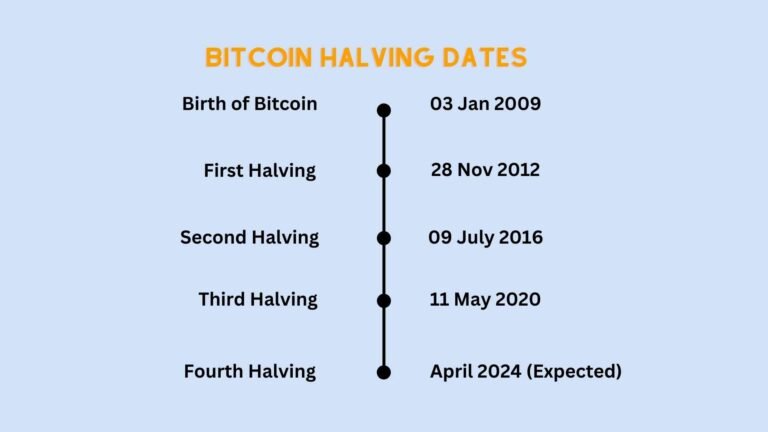
    In Bitcoin halving occurs every 210,000 blocks. There have been three halving as of January 2024.

    1. November 28, 2012 that reduced the block rewards from 50 Bitcoins to 25 Bitcoins.
    2. July 09, 2016 that reduced the block rewards from 25 Bitcoins to 12.5 Bitcoins.
    3. May 11, 2020 that reduced the block rewards from 12.5 Bitcoins to 6.25 Bitcoins.

    There is also a trend that 1 year after each halving date, Bitcoin’s price grows.

    • 1 Year after first halving date : Growth is 8069% (28 Nov 2012 to 28 Nov 2013)
    • 1 Year after second halving date : Growth is 284% (09 July 2016 to 9 July 2017)
    • 1 Year after third halving date : Growth is 538% (11 May 2020 to 11 May 2021)
    Bitcoin Price in History
    Bitcoin Price in History

    First Bitcoin Halving Date 2012

    Closing Price of Bitcoin on 28 Nov 2012 was $12.20.

    At the beginning of Bitcoin, nobody knew the blockchain and its usage. So, there were not many miners who would want to verify transactions. Therefore a high block reward of 50 Bitcoins($610) till November 2012 was given.

    Second Bitcoin Halving Date 9 July 2016

    Closing Price of Bitcoin on 09 July 2016 was $650.96.

    Slowly, as people began to do transactions on the Bitcoin, its demand increased and as a result, its token price also increased. This increased the value of Bitcoin to $963 by 2016 when the second halving occurred. This decreased the block rewards from 25 Bitcoins to 12.5 Bitcoins(=$8,137) after the halving.

    Third Bitcoin Halving Date 11 May 2020

    Closing Price of Bitcoin on 11 May 2020 was $8618.48.

    The third and the last halving decreased the Bitcoin block rewards from 12.5 Bitcoins to 6.125 Bitcoins(=$53,865.5) after the halving.

    #NOTE: There is a trend that after each halving, Bitcoin price increases.

    Fourth Bitcoin Halving Date April 2024 (expected)

    The fourth halving is expected to occur around April 2024 which will reduce the block rewards from 6.25 Bitcoins to 3.125 Bitcoins. Now if Bitcoin even stays at the price range of $41.5k, the reward per block will still be higher than the last halving (2020) at $130,000 after the halving.

    Frequently Asked Questions

    Does halving occur in Ethereum?

    No, halving does not occur in Ethereum because it is a blockchain with an unlimited token supply. Validators are paid with a combination of new tokens and transaction fees.

    Why Bitcoin halving does not occur exactly after 4 years?

    Halving occurs every 210,000 blocks and each block does not exactly 10 minutes as expected. Some blocks take more time and some take less, this leads to the mismatch in timing.