Author: dhirendradas007@gmail.com

  • The 4th Bitcoin Halving Completes, What Now?

    On 20th April 2024, UTC 12:09 am, the Bitcoin network reached a block height of 840,000 and this triggered the Bitcoin Halving event. This reduced the Bitcoin block rewards from 6.25 Bitcoins per block to 3.125 Bitcoins per block. However, there was also a four fold increase in Bitcoin’s block rewards as compared to the third halving event.

    Now that the Bitcoin Halving event has completed. Its finally time to assess what lies ahead now. Turbulent markets, macroeconomics and troubled geopolitics seem to present a lot of challenges ahead.

    Facts About The 4th Bitcoin Halving

    • Old Block Reward was 6.25 BTC per block.
    • New Block Reward at 3.125 BTC per block.
    • Timestamp for the 840,000th block was 12:09 am UTC on 20th April 2024.
    • Price of Bitcoin at halving was $63,984.
    • Next (fifth) estimated Bitcoin halving date between Feb 4th and April 17th, 2028.

    Now that the fourth Bitcoin Halving has finally completed, its time to take a look at what happened and assess what lies ahead.

    The halving event took place at 12:09 am UTC on Saturday 20th April 2024 (19th April for the Americas).

    The new block rewards is at 3.125 Bitcoins per block as compared to the old block reward at 6.25 Bitcoins per block. However, there is an increased payout. At the 3rd Bitcoin halving, the price of Bitcoin was at $8618 which means a block reward was valued at $53,862(6.25 BTC x $8618). This increased to over $200k (3.125 BTC x $63,984) after the 4th Bitcoin halving.

    Bitcoin’s Price to Get 3 Setbacks After The Halving

    First Setback: Miners Selling Bitcoins

    It is expected that around $5 billion worth of Bitcoins might be sold by the miners. The Bitcoin miners have been sitting at their miner rewards since quite a long time. Now that block rewards are half (3.125 BTC per block), some of them might be forced to sell their Bitcoin holdings.

    As per 10x Research this selling might keep Bitcoin under pressure for the next 6 months.

    Second Setback: US Government Selling $2 Billion worth Bitcoins

    Another seller who is ready to sell their Bitcoins is the US Government which is estimated to hold roughly $14.7 billion in cryptocurrencies. Out of this, approximately $2 billion worth of Bitcoins have already been moved to Coinbase on 2nd April 2024 for selling in the open market.

    As per Arkham Intelligence, the government funds were those which were seized from Silk Road, a darknet website founded by Ross Ulbricht (now jailed).

    Third Setback: ETF Outflows

    A third setback would be the slowdown in the Spot ETF inflows. Since, their launch, spot ETFs have seen very generous inflows to the tune of $300 million per day. The highest halving recorded till date was on 12th April 2024 when Bitcoin’s price achieved its first all time high in 2024 (previous one was on November 10, 2021).

    However, the inflows had stopped prior to the having. You can see the chart below to get an idea of Spot ETF inflows and outflows.

    Bitcoin Spot ETF Flows, Coinglass.com
    Bitcoin Spot ETF Flows, Coinglass.com

    Bad Macroeconomics to Hurt Bitcoin

    The US Federal Reserve has clearly suggested that they might not cut interest rates in their next meetings. Fed Chairman Jerome Powell said that the recent readings in US inflation was hotter than expected and this would make it difficult to cut rates in the near future.

    Also pointing towards the recent growth data, he said that there were not sufficient steps taken towards achieving the 2% inflation target. Clearly by steps, he meant there could be more rate cuts or neutral policy decisions in the next few FED meetings.

    Currently, the US inflation rate is at 3.5%.

    The dependence on US inflation and interest rates lies because most of the Bitcoin buyers hail from the USA. Also, the US Spot Bitcoin ETFs far outweigh their global competitors in Assets Under Management (AUM).

    Geopolitical Tensions Might Cease Soon

    The Iran-Israel conflict seems to have ended for now. The conflict was a major cause of Bitcoin’s fall in price from $65k to $60k a few days ago.

    Wars and conflicts typically serve to reduce the market’s appetite for fresh buying.

    Fifth Bitcoin Halving Estimated Between 4th Feb 2028 and 17th April 2028

    The next Bitcoin halving which will further decrease block rewards from 3.125 BTC to 1.5625 BTC is expected to happen between the 4th of February 2028 and 17th of April 2028. This is considering the average time between Bitcoin blocks to be between 9.5 to 10 minutes.

    Price Analysis

    Bitcoin Daily Charts as on 20 April 2024
    Bitcoin Daily Charts as on 20 April 2024

    After touching a low of $60k, Bitcoin has now bounced back taking $61k as its new support zone. However, there is a resistance near $73.2k.

    A move above $73.2k would signal a price rally towards $80k followed by $100k. However, we expect the second target of $100k only to materialize towards the end of the second half (Nov-Dec) of 2024.

    A move below $61k would signal a breakdown in prices and Bitcoin might move rapidly towards $50k-$52k which would be a strong buying zone and hence a strong support.

    Disclaimer: This analysis is for educational purposes and should not be considered trading advice.

    FAQ

    What is Bitcoin Halving, How does it Work?

    Bitcoin Halving is the event that reduces the Bitcoin block rewards to half every four years. Previous halvings were in 2012, 2016, 2020 and 2024. The latest one in 2024 reduced the Bitcoin block rewards from 6.25 BTC per block to 3.125 BTC per block. This is done to increase the scarcity of Bitcoins.

    What does Bitcoin Halving mean for investors?

    For investors, Bitcoin halving means profit, as the value of their Bitcoins will increase due to scarcity. Also, it has been observed that a year after every halving, Bitcoin has given phenomenal results to its investors.

  • Is Bitcoin Mining Still Profitable in 2024? India-based Case Study

    • Bitcoin Mining is still profitable with large professional grade miners.
    • Bitmai’s New Antminer S21 pro could help achieve a break even within a year.
    • After the Bitcoin Halving, a decline in profit will only occur if Bitcoin does not cross $100k.

    Even with all the criticisms, Proof of Work still remains one of the most secure and rewarding consensus mechanism in 2024. With Bitcoin Halving approaching around the 18th of April 2024, one question strikes all minds – Is Bitcoin Mining still Profitable?

    The Answer is yes. If you are using a professional grade mining hardware such as the Antminer S21 (200 Th/s), you would still manage to earn $21 (with electricity cost $16). With latest miners costing around $18.9/Th (Bitmain Antminer S21 Pro), it would barely take you three months to recover your initial setup cost.

    Cost of Bitcoin Mining with Antminer S21 Pro in India

    One of the most advanced Bitcoin miner from Bitmain, i.e., Antminer S21 Pro has efficiency of 15 J/Th and it can mine Bitcoin at a rate of 250 Th/s. The power consumed by the machine comes around 3000W.

    If you consider electricity cost in my region(in Odisha, India), it would cost me somewhere around $0.06 per kWh(unit of electricity). That helps me earn around $16 a day or $500 roughly per month.

    With the latest Bitmain Antminer costing around $4,725, take an additional 18% as taxes, it would roughly be around $5575.

    Note: You could adjust rates according to your region, taxes and cost of electricity and calculate the profitability of your Bitcoin mining setup.

    Effect of the Bitcoin Halving

    Although the halving will reduce Bitcoin’s block rewards to 3.125 BTC per block, still with the expected rise in Bitcoin’s price post-halving, miners would still be profitable.

    With my experience, I estimated same levels of profitability if Bitcoin crosses $100k. Several experts have already signalled that Bitcoin would cross this price levels within H1 of 2022.

    Also if the Macro Diagonal Theory proves correct, this price might be achieved by June 2024.

    Disclaimer: This post is not a promotional post for Antminer. This study has been done with Antminer S21 Pro as an example.

  • Is Bitcoin Mining Still Profitable in 2024? India-based Case Study

    • Bitcoin Mining is still profitable with large professional grade miners.
    • Bitmai’s New Antminer S21 pro could help achieve a break even within a year.
    • After the Bitcoin Halving, a decline in profit will only occur if Bitcoin does not cross $100k.

    Even with all the criticisms, Proof of Work still remains one of the most secure and rewarding consensus mechanism in 2024. With Bitcoin Halving approaching around the 18th of April 2024, one question strikes all minds – Is Bitcoin Mining still Profitable?

    The Answer is yes. If you are using a professional grade mining hardware such as the Antminer S21 (200 Th/s), you would still manage to earn $21 (with electricity cost $16). With latest miners costing around $18.9/Th (Bitmain Antminer S21 Pro), it would barely take you three months to recover your initial setup cost.

    Cost of Bitcoin Mining with Antminer S21 Pro in India

    One of the most advanced Bitcoin miner from Bitmain, i.e., Antminer S21 Pro has efficiency of 15 J/Th and it can mine Bitcoin at a rate of 250 Th/s. The power consumed by the machine comes around 3000W.

    If you consider electricity cost in my region(in Odisha, India), it would cost me somewhere around $0.06 per kWh(unit of electricity). That helps me earn around $16 a day or $500 roughly per month.

    With the latest Bitmain Antminer costing around $4,725, take an additional 18% as taxes, it would roughly be around $5575.

    Note: You could adjust rates according to your region, taxes and cost of electricity and calculate the profitability of your Bitcoin mining setup.

    Effect of the Bitcoin Halving

    Although the halving will reduce Bitcoin’s block rewards to 3.125 BTC per block, still with the expected rise in Bitcoin’s price post-halving, miners would still be profitable.

    With my experience, I estimated same levels of profitability if Bitcoin crosses $100k. Several experts have already signalled that Bitcoin would cross this price levels within H1 of 2022.

    Also if the Macro Diagonal Theory proves correct, this price might be achieved by June 2024.

    Disclaimer: This post is not a promotional post for Antminer. This study has been done with Antminer S21 Pro as an example.

  • Bitcoin Falls Due to $1.6bn GBTC Selling by FTX

    Bitcoin has witnessed a selling pressure after the ETFs were approved on the10th of January 2024. The cryptocurrency made a high of $48,939 on 11 Jan 2024 after the ETF approval. The price then fell to $38,521 on 23 Jan 2024 witnessing a sell-off which was accompanied with rumors of profit booking.

    FTX Sells $1.6 Billion GBTC Shares due to Bankruptcy

    Bitcoin Price from 24 Dec 2023 24 Jan 2024
    Bitcoin Price from 24 Dec 2023 24 Jan 2024

    Although, there was a bit of profit booking taking place in the market, yet, the main reason we found was that FTX sold nearly $1.6 billion worth of Grayscale Bitcoin Trust (GBTC) shares. Since the shares were redeemed by FTX, the Bitcoin in those shares had to be sold off which cost the market to fall.

    In total, GBTC saw outflows of about $2 billion out of which, FTX alone sold $1.6 billion worth of shares. The bankruptcy of the FTX made it compulsory for it to sell those shares to pay its debtors which sold 22.28 million shares were sold via Mirax Capital.

    Grayscale Bitcoin ETF became the largest one after the Grayscale Bitcoin Trust was allowed by the SEC to convert it into an ETF. At the time of the conversion, the net value of assets under management were $28.6 billion.

    As on 24 Jan 2023, it still has $24 billion with of assets.

    Grayscale Bitcoin Trust AUM
    Grayscale Bitcoin Trust Details

    #NOTE: The Grayscale Bitcoin Trust had bought Bitcoins on the basis of whose value, it issued shares. Anyone with a GBTC share was entitled to own a part of those Bitcoins.

    Experts Comments on Bitcoin Sell-off

    We have gathered few expert insights that help us decode the post ETF sell-off in Bitcoin.

    Markus Theilsen, Head, 10x Research

    In his WhatsApp community (of which I am a member), Markus Thielen noted that FTX sold off at least $1.6 billion Bitcoins in two tranches.

    The first tranche was sold on 23 Jan 2024 which had $1b worth of Grayscale’s Bitcoin ETF.

    The second tranche had nearly 17,140 Bitcoins and it was deposited to Coinbase on the same day. The value of the second tranche was nearly $660 million.

    Cathie Wood, CEO, ArkInvest

    Cathie Wood on Bitcoin Recent Decline, Source CNBC

    Appealing on the CNBC ArkInvest CEO Cathie Wood said that now the Bitcoin ETFs are now available at very reasonable price. This helps retailers to buy Bitcoins at a very small price.

    She also shared that FTX was selling the shares of Grayscale Bitcoin Trust worth over $1 billion which currently is the main reason behind the decline of Bitcoin’s price.

  • What are Smart Contracts?

    Smart Contracts are pieces of codes that automatically execute blockchain transactions based on a set of inputs given. These are basically used to automate activities such as crypto swaps, NFT minting, token sale, liquidity pools, escrow funds, etc.

    Smart Contracts feature decentralized execution of tasks on a blockchain without the need of a central party as a guarantor.

    #NOTE: All interactions with a smart contract are in the form of transactions and require necessary gas fees.

    Definition, Working and Example

    A smart contract is basically a program that facilitates the execution of transactions on a blockchain. Once programmed smart contracts basically become tamper-proof and fully automated.

    Smart contracts can be used to automate tasks such as Decentralized Exchanges, Auctions, Crypto Swaps, NFT trading, etc.

    Working of a Smart Contract in Simple Terms

    A smart contract works in a very simple way:

    1. The creator of a smart contract creates a logic. It can be based on agreement between parties(such as Escrow) or in case of a solo creator, their needs and wishes(such as a Legal Will).
    2. The smart contract is programmed based on the requirements.
    3. Triggering conditions are set. These conditions can either be based on time or on specific actions.
    4. In case of external conditions triggering smart contracts, a blockchain oracle is required to feed data to it.
    5. The smart contract is executed based on its conditions.
    6. The resulting transaction, for example, transfer of funds, is recorded on the blockchain.
    How Smart Contract Works
    How a Smart Contract Works

    Example

    Let me use the example of an auction to show how a smart contract works.

    Suppose there is an auction where people are bidding for an iconic piece of art. Now this art can be an NFT or a real world painting. To ensure that the auction goes free and fair, the auctioneers have used a smart contract.

    They have programmed it in a certain way that whoever is the highest bidder at 09:00 AM on February 7th, will automatically be the winner of the auction,

    In real life, there could emerge a problem in such situations. If several people are betting on the same thing just before it ends, it would be impossible to accurately judge who did the last and the highest bid.

    Even if you use a digital bidding system, the trust on them would be zero. I observed this when there was an allegation on Rarible for insider trading.

    In such situations, blockchain-based bidding makes absolute sense since it can be verified and its history is immutable.

    Working of a Smart Contract in Technical Terms

    A smart contract uses various functions and logic to execute its actions. These functions and logic trigger actions such as transfer or funds, NFTs, Asset Tokens or other actions.

    The transfers take place via public addresses on the blockchain. There are 4 types of addresses which are required to execute such transfer-based smart contracts.

    • Public address of the creator (Master Address).
    • Public address of the Smart Contract.
    • Public address of the beneficiary.
    • Public address of other parties (for example in smart contracts for auctions or governance).

    After that, the smart contract is coded and works in this way.

    1. The logic is coded based on the agreement between parties or the will of the creator.
    2. The structures(user defined data types) are created for entities which are present in the smart contract. In the below example they are: Voter and Proposal. The item for which the smart contract is created is also an entity. Example of such entities are NFTs in Auctions.
    3. Then the functions are defined along with their logic. A function is the piece of code which defines the working of a smart contract if its conditions are met.
    4. A failsafe function is also created which gets executed when no other function is executed. Such as return funds to XYZ address if an auction fails.

    Example of a Solidity Smart Contract Code for Governance

    Below is a sample smart contract code of a voting system built using the Solidity programming language. Source: Remix IDE.

    Benefits of Using Smart Contracts

    1. Smart Contracts are fast in execution and barely take a few seconds or a few minutes to execute.
    2. They are free of any bias. No third party involvement eliminates the question of bias.
    3. They are transparent as blockchain transactions are open for verification by anyone.
    4. Encryption of data provides a high degree of security.
    5. Smart contracts save money as the fees for a third party is not required.

    Disadvantage – Non-Editable

    In my experience, the greatest disadvantage of using a smart contract comes when there is a need to change them. Even for the smallest changes, I have seen developers deleting and re-deploying an new smart contract.

    I am well aware that these feature contributes to their security but deploying a new smart contract every time changes its address and tokens sent to the old address are simply lost.

    Applications and Use

    Smart contracts are used extensively these days in Decentralized Exchanges, DApps, Swap Protocols, Liquidity Protocols, Blockchain Bridges, Escrow Accounts, etc.

    Decentralized Exchanges

    Simplified Working of a Decentralized Exchange
    Simplified Working of a Decentralized Exchange

    Perhaps the most widely used application of a smart contract is its usage in the decentralized exchanges. Since, these exchanges are automated they need some tool to facilitate the automated exchange of cryptocurrencies. This role is fulfilled by smart contracts.

    With some DEXes, you might also get an option to do cross chain transfers.

    Swap and Liquidity Protocols

    How Swapping Protocol Works

    These protocols rely on smart contracts to provide swap features and generate LP tokens.

    Smart contracts facilitate the swapping of assets on the same blockchain (such as between USDT and WBTC on Ethereum).

    They also help generate Liquidity Provider Tokens(LP Tokens)

    LP tokens are those cryptocurrencies which you get once you deposit some liquidity(popular cryptocurrencies) to a liquidity pool. These LP tokens are required to claim back your original crypto along with its rewards.

    Blockchain Bridges

    How does a Blockchain Bridge Work
    How does a Blockchain Bridge Work

    Blockchain Bridges use two sets of smart contracts to transfer assets between different blockchains. One smart contract locks the assets on one chain and another smart contract mints them on another blockchain. While redeeming the tokens, the same method is followed.

  • What is a Halving? Meaning with Bitcoin as an Example

    Halving means a phenomenon in blockchains by which block rewards are reduced to half of their previous value. This is done to keep a limit on the amount of new coins entering the circulating supply.

    Though halving is not seen in all blockchains, it is mostly common for blockchains with a limited coin supply.

    #NOTE: Block rewards are the share of transaction fees that are awarded to those who verify the transactions and add new blocks to the blockchain.

    Definition

    Halving refers to the reduction of block verification rewards by 50% every certain number of years (for Bitcoin it is 4). This reduction in the creation of new tokens makes the tokenomics less inflationary, increasing the token value. Further, halving also indirectly forces users to use the blockchain token for their personal transactions, bringing in utility for the token.

    #Note: Halving rewards are the only way new tokens are created in major public blockchains like Bitcoin. Therefore, lowering the rewards introduces a smaller number of coins in circulation, helping in token value appreciation.

    Why Halving is Necessary? Its Benefits and Significance

    Halving becomes necessary in blockchains due to a few reasons. It keeps the coin supply within reasonable limits and therefore helps alleviate the value of the coins. Halving also promotes the usage of transaction fees only to pay miners/validators so that the blockchain becomes intrinsically sustainable.

    1. Limit on Coin Supply

    Halving works best for those coins that have a limited supply, for example, Bitcoin, which has a limit of 21 million coins.

    Further, adding more coins dilutes the value of older coins due following the law of demand and supply.

    However, adding a hard cap during the time of launch does more harm than benefit. Because if the blockchain is not adopted instantly, then there would be very less transactions and therefore validators won’t be paid which would make them abandon the work.

    Therefore, some token supply is kept as unmined coins which are released slowly to the miners or validators in a controlled manner. This way of releasing new coin supply does not act as a shock and is easily absorbed.

    2. Helps Price Appreciation

    A reduced coin supply is beneficial as it helps increase the demand of those coins which are in circulation. For example, when Bitcoin halving occurs, it reduced the coin supply and after each Bitcoin halving, the coin value appreciates.

    We observed this each time Bitcoin halving occurred. You can see the price of Bitcoin vs halving events below.

    3. Makes the Blockchain Self Sustainable

    During the initial days of any blockchain, only a few users were use it. However, to keep it authentic there were special users called miners who checked and approved transactions to make sure they were valid.

    To encourage these miners, the blockchain automatically rewarded them with cryptocurrencies every time they successfully completed a set of verifications, which we call a block.

    However, it couldn’t keep giving out lots of coins forever, otherwise the price of the coin will collapse due to over supply.

    So, after a certain number of blocks (every 210,000 in Bitcoin), the rewards became smaller. This would theoretically make the blockchain miners rely more on transaction fees and not on block rewards.

    What Happens after Halving?

    After halving, usually the price of the coin appreciates as after this situation, there will be a lesser amount of coins that will enter the markets.

    Further, since the block reward decreases, miners/validators get reduced block rewards. However, they also get rewards from increased transactions as more users are seen to be attracted towards the blockchain due to reduced prices.

    Bitcoin Halving History

    Bitcoin Halving Dates vs Price , Source: Techopedia.com
    Bitcoin Halving Dates vs Logarithmic Price, Source: Techopedia.com

    In Bitcoin halving occurs every 210,000 blocks. There have been three halving as of January 2024.

    1. November 28, 2012 that reduced the block rewards from 50 Bitcoins to 25 Bitcoins.
    2. July 09, 2016 that reduced the block rewards from 25 Bitcoins to 12.5 Bitcoins.
    3. May 11, 2020 that reduced the block rewards from 12.5 Bitcoins to 6.25 Bitcoins.

    There is also a trend that 1 year after each halving date, Bitcoin’s price grows.

    • 1 Year after first halving date : Growth is 8069% (28 Nov 2012 to 28 Nov 2013)
    • 1 Year after second halving date : Growth is 284% (09 July 2016 to 9 July 2017)
    • 1 Year after third halving date : Growth is 538% (11 May 2020 to 11 May 2021)
    Bitcoin Price in History
    Bitcoin Price in History

    First Bitcoin Halving Date 2012

    Closing Price of Bitcoin on 28 Nov 2012 was $12.20.

    At the beginning of Bitcoin, nobody knew the blockchain and its usage. So, there were not many miners who would want to verify transactions. Therefore a high block reward of 50 Bitcoins($610) till November 2012 was given.

    Second Bitcoin Halving Date 9 July 2016

    Closing Price of Bitcoin on 09 July 2016 was $650.96.

    Slowly, as people began to do transactions on the Bitcoin, its demand increased and as a result, its token price also increased. This increased the value of Bitcoin to $963 by 2016 when the second halving occurred. This decreased the block rewards from 25 Bitcoins to 12.5 Bitcoins(=$8,137) after the halving.

    Third Bitcoin Halving Date 11 May 2020

    Closing Price of Bitcoin on 11 May 2020 was $8618.48.

    The third and the last halving decreased the Bitcoin block rewards from 12.5 Bitcoins to 6.125 Bitcoins(=$53,865.5) after the halving.

    #NOTE: There is a trend that after each halving, Bitcoin price increases.

    Fourth Bitcoin Halving Date April 2024 (expected)

    The fourth halving is expected to occur around April 2024 which will reduce the block rewards from 6.25 Bitcoins to 3.125 Bitcoins. Now if Bitcoin even stays at the price range of $41.5k, the reward per block will still be higher than the last halving (2020) at $130,000 after the halving.

    Frequently Asked Questions

    Does halving occur in Ethereum?

    No, halving does not occur in Ethereum because it is a blockchain with an unlimited token supply. Validators are paid with a combination of new tokens and transaction fees.

    Why Bitcoin halving does not occur exactly after 4 years?

    Halving occurs every 210,000 blocks and each block does not exactly 10 minutes as expected. Some blocks take more time and some take less, this leads to the mismatch in timing.

  • Coins vs Tokens in Cryptocurrency

    Cryptocurrencies is the widest term of all and covers all type of digital currencies irrespective of blockchains. Coins are those cryptocurrencies which exist primarily on their own blockchain. Tokens are those cryptocurrencies which exist on other blockchains; and might or might not have their own blockchain.

    Let us explore briefly the confusion between coins vs tokens and understand what make them different.

    Definitions

    Cryptocurrencies are digital assets on a blockchain that can be used in a similar way as fiat currencies. They satisfy all the requirements of a currency such as fungibility, store of value and are widely accepted.

    Properties of Fiat Currency

    Fiat currency has some properties which must be followed by every asset that need to be called a currency. Some of them are fungibility, storage of value and wide acceptance.

    Fungibility

    Fungibility
    Fungibility

    Fungibility is the property through which an asset such as a currency can be divided in to smaller parts. The following two examples depict how Bitcoin is more fungible than fiat currencies such as US Dollar.

    For example:

    • A US Dollar($) can be divided into 100 cents.
    • An Indian Rupee (₹) can be divided into 100 paisas.
    • A Bitcoin can be divided in to 100 Million Satoshis.

    Store of Value

    Store of Value
    Store of Value

    Store of Value is the property of currencies which helps people store them for future needs. Currencies need to have a way through which they can be stored and be of value even after a long time. Cryptocurrencies can be held on as savings or investments and can be used at a late stage.

    The above image shows how more than 68% of Bitcoin owners have held to their Bitcoins for over a year now.

    Wide Acceptance

    Wide Acceptance
    Wide Acceptance

    Wide Acceptance is also a major aspect of a currency because it cannot be freely used otherwise. Cryptocurrencies satisfy this aspect as millions of people across the world, including me, accept cryptocurrencies as a mode of payment.

    Coins vs Tokens

    By definition coins are those cryptocurrencies which have their own blockchain. For example, Bitcoin has its own blockchain where its cryptocurrency exists. Similarly, Shiba Inu is a coin when it exists in its own blockchain, Shibarium.

    Tokens are those cryptocurrencies which either do not have their own blockchain or are those which are transferred to a different blockchain.

    For example, USDT is a token on the Ethereum Blockchain because USDT does not have its own blockchain. Similarly, Shiba Inu when it is an ERC20-standard token, it is a called to be a token on the Ethereum blockchain and not coin.

    Coins vs Tokens
    Coins vs Tokens

    Let me give you another example. Bitcoin is a coin on its own blockchain but when it is send to the Ethereum blockchain, it takes the form of a ERC20-token called Wrapped Bitcoin (wBTC). This Wrapped Bitcoin is a token on the Ethereum Blockchain.

    Fungible vs Non-Fungible Tokens

    Basically, fungible tokens ae those which can be divided into smaller units and non-fungible tokens are those which cannot be subdivided.

    #NOTE: There is another token category on Ethereum called Semi Fungible token which can be issued in both fungible and non-fungible forms. Its token standard is ERC-1151.

    Fungible Tokens

    Fungible Tokens are those which can be divided into numerous smaller denominations which can be sent and received independently. For example a Bitcoin can be divided into 100 Million Satoshis each of which can be sent individually.

    #NOTE: This property of Bitcoin which enables independent transaction of each Satoshi, has given rise to Ordinal Theory based on which Bitcoin Ordinals (NFT-like tokens on Bitcoin’s blockchain) were created by Casey Rodarmor.

    Non Fungible Tokens

    On the other hand Non-Fungible Tokens are those which are transacted individually and cannot be divided into smaller groups. These tokens are minted on a blockchain and can be transferred to other blockchains via cross-chain transfer protocols such as a Blockchain Bridge.

    Non-Fungible tokens usually represent digital or real world assets and can be used to trade the ownerships of these assets. For example, real world land or building can be tokenized and sold via the blockchain. This process is called as Asset Tokenization.

  • What is a Gas War?

    In Ethereum, Gas War means a competitive situation where senders compete for gas fee to get their transactions executed in priority. Since, Ethereum transactions are auctioned to the highest bidder, the bidding results in spiraling up of bids which eventually results in a unsustainable gas price.

    Why Gas Wars Take Place?

    Ethereum never worked earlier on increasing its transactions speed because it thought doing so might reduce the security of the blockchain.

    This caused its transaction speed to remain stagnant at 10-15 TPS.

    However, this could not match the growing demand of the time and soon people had to wait un queue to get their transactions executed. Those who paid a higher fees got their transactions executed first.

    The only reason why Gas Fees are still high because most users prefer Ethereum for its security.

    During times of increased demand for transactions such as during airdrops, during NFT minting, or launch of popular DApps, the competition for gas increased to become Gas Wars.

    Need of Gas in Ethereum

    In the Ethereum Blockchain, gas is used to estimate the amount of work done by validators to verify transactions. The higher the work needed, the higher will be gas fees.

    Work is required to execute operations such as sending transactions, deploying smart contracts, or interacting with decentralized applications (DApps).

    For example, NFT transactions need higher work to validate them and therefore have a higher gas fees than Ethereum.

    Gas Fee Comparison in Ethereum
    Gas Fee Comparison in Ethereum

    What is Ethereum doing to avoid Gas Wars?

    Gas wars present a brutal scenario where small transactions are not economically viable because several times the transacted value is much lesser than the gas fees.

    Therefore, to reduce Gas fee, users use two methods to decrease transaction costs. They are Zero Knowledge Rollups and Optimistic Rollups. Both these processes rely on off-chain work which might compromise Ethereum’s security.

    Ethereum has also currently implemented a third way called Proto-Dank Sharding which helps reduce its dependency on other blockchains.

    Zero Knowledge Rollups

    Though Ethereum has not done much until 2024 for decreasing pressure on Gas Fees, other blockchains presented them as Layer-2 scaling solutions and helped offload the pressure on Ethereum by validating Ethereum transactions out of the Ethereum blockchains and submitting a summary of these transactions.

    When the summary is found to be true, all the transactions are also validated at the same time because the final state of the blockchain after the transactions is as expected.

    The entire process is known as Zero Knowledge Rollup because only the summary of transactions are kept and individual transaction details do not exist on Ethereum and it has no knowledge of the off-chain (Layer-2) transactions.

    Optimistic Rollups

    Optimistic Rollups also summarize transactions and only submit a summary of them for validation by Ethereum. But, there is a small difference between Zero Knowledge and Optimistic Rollups.

    Optimistic Rollups use call-data where the individual transactions (of the summary) are written. Call data is a space on the Ethereum block which is not validated by validators.

    This process decreases the transaction costs but also makes the blocks bulky because all the individual transaction data is still present inside the block.

    Proto-Dank Sharding

    Proto-Dank Sharding is a process where a feature called a “Blob” is attached to each block and this blob stores all the individual transaction data. The blobs do not make Ethereum blocks heavy because each blob in a block is deleted after 3 months of creation.

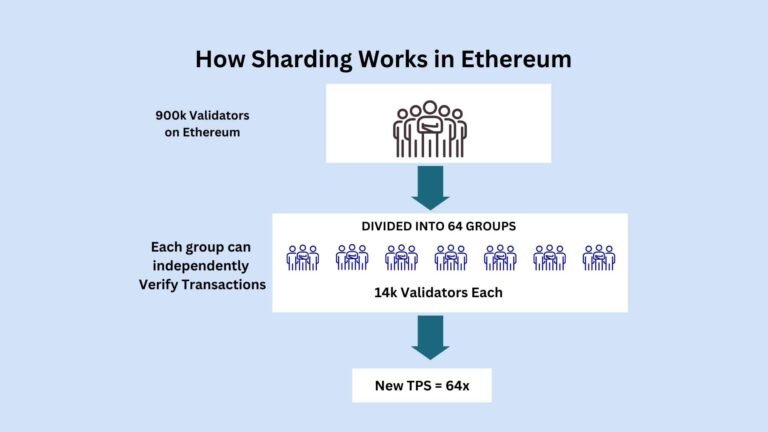
    This is different than Sharding which aims to increase the speed of Ethereum by dividing its 900k validators in to smaller groups each of which can independently verify transactions and add blocks to Ethereum.

  • What is Gas Fees? How does it work in Ethereum?
    Gas fee is the transaction fee charged in the Ethereum blockchain. The fee is paid to Ethereum validators for verifying transactions and adding blocks to the blockchain.

    The term originated in the Ethereum blockchain but is now widely used to refer to transaction costs in other blockchains too.

    How is Gas Fee Calculated?

    Gas fees are calculated on the basis of network congestion. If a network is highly congested, like Ethereum, its gas fees will definitely be high. These usually happens in a network with low TPS (transaction per second) like Ethereum (10-15 TPS).

    Similarly, for networks with higher TPS like Solana (avg. 3000 TPS on 18 Jan 2024) there is less network congestion and therefore gas fees is low.

    Gas Auctions

    In Ethereum, gas fees are denominated in Gwei and are auctioned to the highest bidder. Bidders big on the amount they are willing to pay and the highest bidder gets to send their transactions first.

    However, this does not mean that anyone can bid any random amount to send their transactions first.

    Gas Price Categories in Gas Auctions

    Usually there are three categories of gas fees that a user buys to send a transaction. They are Low, Average and High.

    The below screenshot from Etherscan’s gas tracker shows the three available options for gas auctions.

    Categories of Gas Fees
    Categories of Gas Fees

    The low gas fee category has the least priority and gets executed at the last. The priority to execute the transactions increases with the bidding amount which is visible as 31 Gwei, 32 Gwei and 35 Gwei.

    Gas Limit

    Usually there is a cap of the Gas that can be used to send a transaction and this limit is called the Gas Limit. This limit can be set by the user who sends a transaction. Most wallets like MetaMask feature a gas fee limit setting which allows the user to pay gas fees within a limit.

    Gas fee and gas limits differ on Ethereum for tokens and NFTs since the latter needs much more validation work to be able to process. Therefore, NFT gas fees are usually higher than gas fees for Tokens.

    Here is a snapshot from Etherscan that shows the gas fee details for various actions. See how NFT sale needs the highest amount of Gas Fee. Other actions like token swapping, bridging, and borrowing costs much less.

    Gas Wars

    Gas Wars are scenarios where too many people compete with each other to send their transactions first. This causes a scenario where people compete very violently and it seems that there is a war to execute transactions.

    Such wars usually occur during specific events such as Airdrops, Free NFT minting and when DEXs are launched.

    Problem of High Gas Prices in Ethereum

    Ethereum had a problem of high gas costs during 2018 when its popularity rose. This caused users flock to it and start transacting on the blockchain. As a result, its Gas Prices elevated.

    Other factors which have resulted in high prices in Ethereum are its high degree of security, majority share in NFT markets, and the sheer number of DeFi protocols associated with it. Ethereum still commands 59% of the total volume in DeFi markets.

    Also, Ethereum witnesses the highest DApp development than any blockchain.

    These causes a perpetual demand of Ethereum for various transactions.

    However, Ethereum still has the 10-15 TPS speed which has not changed over time. This causes a network congestion.

    Solutions for Combating High Gas Fees

    Currently there are 3 solutions being used for combating high gas fees in Ethereum. However, all these are temporary and the ultimate solution is supposed to be the Surge, which is expected to help Ethereum reach 100k TPS (transactions per second) from the current TPS of 15.

    Zero Knowledge Rollups

    Though Ethereum has not done much until 2024 for decreasing pressure on Gas Fees, other blockchains presented them as Layer-2 scaling solutions and helped offload the pressure on Ethereum by validating Ethereum transactions out of the Ethereum blockchains and submitting a summary of these transactions.

    When the summary is found to be true, all the transactions are also validated at the same time because the final state of the blockchain after the transactions is as expected.

    The entire process is known as Zero Knowledge Rollup because only the summary of transactions are kept and individual transaction details do not exist on Ethereum and it has no knowledge of the off-chain (Layer-2) transactions.

    Optimistic Rollups

    Optimistic Rollups also summarize transactions and only submit a summary of them for validation by Ethereum. But, there is a small difference between Zero Knowledge and Optimistic Rollups.

    Optimistic Rollups use call-data where the individual transactions (of the summary) are written. Call data is a space on the Ethereum block which is not validated by validators.

    This process decreases the transaction costs but also makes the blocks bulky because all the individual transaction data is still present inside the block.

    Proto-Dank Sharding

    Proto-Dank Sharding is a process where a feature called a “Blob” is attached to each block and this blob stores all the individual transaction data. The blobs do not make Ethereum blocks heavy because each blob in a block is deleted after 3 months of creation.

    How Sharding is supposed to work in Ethereum
    Sharding in Ethereum

    This is different than Sharding which aims to increase the speed of Ethereum by dividing its 900k validators in to smaller groups each of which can independently verify transactions and add blocks to Ethereum.

    Frequently Asked Questions

    What Is a Gas Fee on NFTs?

    On the block height of 190333373 the Gas Fee for NFT was in the range of $51.91 – $53.44.

    What Is Ethereum’s Gas Fee Now?

    Ethereum gas fees is highly volatile and changes every 15-20 seconds. I witnessed the gas fee to be $31.62 max for Token transfers and $53.44 max for NFT sales at the block height of 190333373 .

    Why do I have to pay a Gas Fee?

    The gas fee is basically meant to pay the validators for their work in securing the blockchain and validating transactions. Therefore any transaction that needs to be validated and processed must pay a Gas Fee.

    How can I pay less Gas Fee in Ethereum?

    To pay less gas fees in Ethereum, use L2 blockchains like Polygon, Arbitrum and Optimism and transfer your Ethereum assets to these blockchains.

    If you do not want to pay any fees, transfer crypto within your preferred exchange. I use CoinDCX for Indian transfers and Binance for international since both of them are widely used. Any transfer outside the exchange will cost you Gas Fee.

  • What are Block Headers?

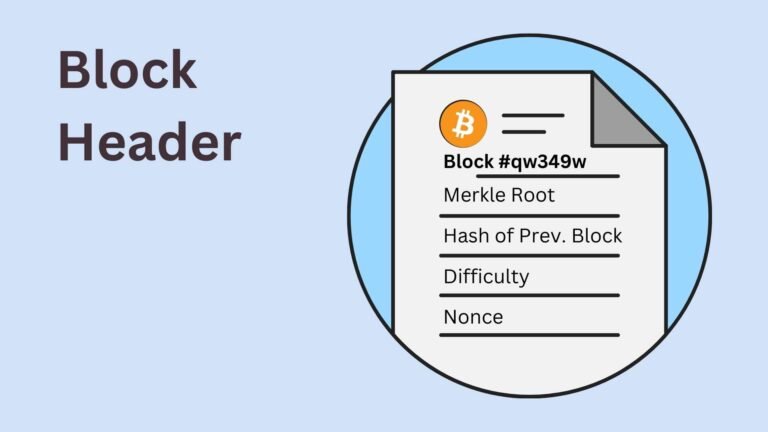
    Block Headers are the meta data of each block on a blockchain. They contain details such as nonce value, hash of previous block, timestamp, difficulty target, etc.
    Block headers play a crucial role in the blockchain’s safety.

    Once the block header is assembled, it is hashed to obtain block hash or block ID which is unique for every block in the blockchain.

    Components of a Block Header

    A block header is composed of several data points below.

    1. Version Number

    Version number is the identifier of the format of the block which is in use for that blockchain. Formats change after soft forks and hard forks.

    Format numbers are incremental and they increase as the block height progresses.

    2. Previous Block Hash

    Hash is the result of running all the information in the block through a hashing function. Usually, hashes of a block are the Merkle Roots of the block.

    The hashing function is a non-reversible function which means that once you can get a hash out of some information but you cannot get back the original information by reversing the hash function or by any means.

    For example, you make an apple pie (similar to a hash value) from flour, sugar and apple (similar to transactions details, merkle root and previous block’s header), but you cannot recreate the apple from the apple pie.

    3. Merkle Root

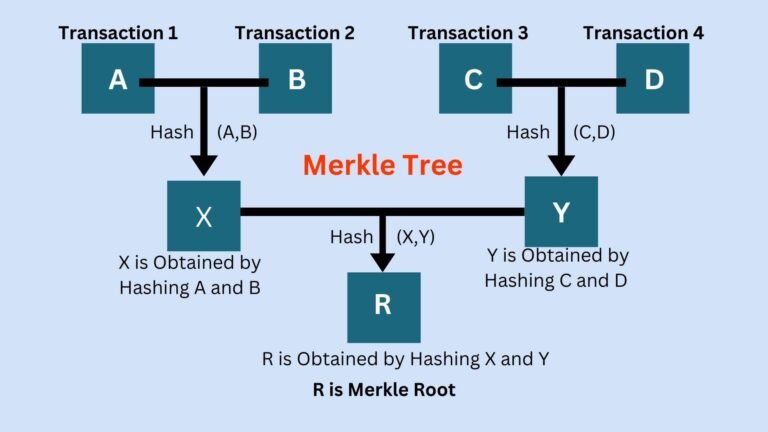
    A merkle root is the hash of all the values of preceeding transactions in a blockchain. To obtain a merkle root, transactions are hashed in pairs till the time there is just a single merkle root derived from all transactions.

    This is a very crucial component of blockchain security because any change in any element in the Merkle Tree would change the value of the end Merkle Root.

    4. Timestamp

    A timestamp records the time when a block was created. Different blockchains have different methods of adding timestamps to a block. In most cases these timestamps are added by the miner. However, in the case of Proof of History, there is a function called the Verifiable Delay Function (used in Solana) which automatically adds timestamps to each block.

    5. Difficulty Target

    Difficulty target specifies the level of difficulty that a validator (who verifies transactions) must encounter and overcome to get the nonce value for that block.

    6. Nonce Value

    A nonce value is a number that is used to find a hash that meets the difficulty target. This nonce value is generated in several ways.

    In Bitcoin a nonce value is obtained by selecting a random number and incrementing it till the resultant hash meets the difficulty target.

    In Ethereum this nonce value is obtained by validators by putting down a collateral which is seized if they introduce errors in the blocks.

    In Proof of Capacity consensus mechanism, nonce values are stored in the local disk of the validator in advance. The validator just has through scan the local disk to obtain it.

    7. Any other information